

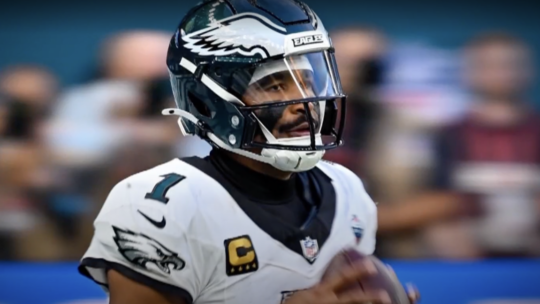
PR roundup covers what NFL quarterback Jalen Hurts' blood clot event reveals about the dangers of fragmented crisis communications, new research showing that a single AI visibility score can hide as much as it reveals and why Chipotle’s Boorito is a 25-year lesson in building a brand tradition that actually belongs to your customers.
How the Eagles and NFL Handled Jalen Hurts’ Blood Clot Diagnosis—and What Happens When Facts Emerge in Pieces
What happened: Philadelphia Eagles quarterback Jalen Hurts expects to miss the rest of the 2026 NFL season after doctors discovered blood clots in both of his lungs—a diagnosis that evolved over nearly two weeks, through international travel and raised serious questions about how his medical situation was handled.
According to CBS Sports, doctors first discovered a superficial blood clot in Hurts’ calf on Oct. 10 during a visit to the Cleveland Clinic in London, England, the day before he played in the Eagles’ game against the Jacksonville Jaguars. A follow-up appointment on Oct. 14 revealed the clot had moved, and by Oct. 19 the diagnosis escalated to deep vein thrombosis with blood clots developing in both lungs.
The communications picture has been just as complicated as the medical one. The Eagles initially did not plan to place Hurts on injured reserve, then did so hours later, per sports media reports. The news circulated that Hurts had been told not to sleep for 36 hours before the London game due to his condition—a claim NFL Executive Vice President Jeff Miller rejected. CNN reported Miller calling it “considerable and uninformed speculation.” The NFL concluded the process for clearing Hurts to play was “handled appropriately” and said it would not punish the Eagles, according to The Athletic. The NFLPA pushed back immediately, per Yahoo Sports, calling for a full independent investigation and noting the league had previously told the union it didn’t plan to review the care Hurts received. Commissioner Roger Goodell subsequently said the league would “welcome” an investigation, per ESPN.
On Oct. 19, the Eagles and Hurts’ agent issued a joint statement confirming the updated diagnosis, describing his prognosis as “very good” and outlining his treatment plan. The statement was notably transparent—detailed, signed jointly by the team and the player’s representative—and proactive in addressing public concern.
Communication takeaways: The situation illustrates how quickly a medical story can become a crisis narrative when facts emerge in pieces and conflicting reports fill the vacuum. The Eagles’ early communication was fragmented—the injured reserve reversal and unresolved timeline questions left space for misinformation. The joint statement from the team and Hurts’ agent provided a more effective approach, presenting a unified, clear message from parties whose interests might otherwise appear misaligned. The NFLPA’s call for investigation—regardless of outcome—will ensure the story continues well past the initial news cycle.
Michelle Bonner, VP of Public Relations at Adams & Knight, couldn’t help but recall her days as an NFL reporter, when New England Patriots quarterback Drew Bledsoe suffered a hemothorax in 2001, a serious injury that caused internal bleeding into his chest. What stands out to her years later is how the Patriots handled the medical questions.
“When Bledsoe got cleared to play, they didn’t put Coach Bill Belichick in the position of trying to explain complicated medicine,” Bonner says. “They held a press conference at Massachusetts General Hospital with Bledsoe, the Patriots’ team physician, the doctor who treated him and the hospital’s chief of surgery. The physicians walked reporters through what had happened, the timeline and the medical reasoning.”
Bonner remembered that the team physician essentially said that there were medical questions the coach simply couldn’t answer—so the doctors were there to answer them. She sees an important lesson in that in relation to the Eagles' crisis.
“A head coach can answer whether a player practiced, whether he is available and how an injury affects the football team,” she says. “But when the questions become about blood clots, vascular medicine and the clinical decisions surrounding whether a player was cleared to travel and play, those questions belong with medical experts. I keep coming back to why Eagles’ coach Nick Sirianni was the person standing at the microphone fielding these questions. This wasn’t a routine “he’s day-to-day with a high ankle sprain” update.”
Bonner notes that it doesn’t mean Sirianni explaining what happened was wrong, it just means “recognizing that reassurance has much more credibility when it comes from the people qualified to explain the medicine.”
Bonner also recognizes a broader reputational issue—the NFL’s biggest vulnerability regarding a long-running trust issue: whether player health and safety come first.
“The league does not enter a player-safety controversy with a completely blank slate,” she says. “There is already a perception among some players, former players and fans that the NFL has at times been reactive rather than proactive on health and safety. The years of controversy and litigation surrounding concussions and CTE are perhaps the clearest example. Thousands of former players ultimately sued the league, alleging it had concealed concussion risks, and the NFL reached a major settlement while continuing to deny wrongdoing.”
The lesson? History matters in crisis communications.
“People do not evaluate a new controversy in isolation,” Bonner says. “So when the initial message in a situation involving a serious medical diagnosis sounds like, “We see no reason to investigate further,” that can reinforce an existing perception that the institution is protecting itself rather than asking every possible question about player safety.”
Study: Four AI Engines, Four Different Shortlists—Why a Single “AI Visibility” Score Can Mislead
What happened: A new benchmark from Crackle PR suggests that brands relying on blended AI visibility scores may be getting a false read on where they actually stand. The Q4 2026 AI Visibility Index asked ChatGPT, Claude, Grok and Perplexity the same 25 questions about choosing a B2B tech PR agency—500 answers total—and found that the four engines largely disagree on who to recommend.
By the numbers:
- 17%: average overlap between different AI engines recommending the same agencies for the same question
- 43%: average overlap when the same engine was asked again—showing the disagreement is engine-specific, not random noise
- 23 of 23: eligible questions where same-engine overlap exceeded cross-engine overlap
- 22.0 vs. 0.7: Edelman’s score on Claude versus ChatGPT—same agency, wildly different visibility depending on the engine.
Communication takeaways: Depending on which engine a monitoring tool weighs most heavily, the same agency could be told it leads AI search or barely registers. The findings reinforce what earlier GEO research flagged this year: AI visibility is not a single number. Strategies built around optimizing for one engine may leave significant gaps on others—and a blended score won’t tell you where those gaps are.
“Brands are being handed one number for their AI visibility, and our data says that number is an average of engines that don’t agree with each other,” says Parry Headrick, founder of Crackle PR. “One engine puts an agency on the shortlist while another doesn’t mention it at all. A blended score can tell you you’re winning when you’re invisible to the assistant your buyer actually uses.”
Based on the findings, Crackle PR recommends that brands and their agencies:
- Don’t settle for a blended score. A single number can make you look great on one engine while you’re nearly invisible on another. Track visibility on individual engines to compare.
- Ask the same question more than once. Even the same engine only agreed with itself 43% of the time—one answer tells you very little.
- Find out how your monitoring tool weights the engines. The mix behind a blended score can change the result dramatically, even when nothing else does. Ask how the engines are weighted.
Chipotle’s Annual Boorito Returns
What happened: Some brand traditions earn their place on the calendar. Chipotle’s Boorito is one of them. For more than 25 years, the fast-casual chain has turned Halloween into a PR moment, and this year is no different: Chipotle Rewards members who show up in costume at any participating U.S. location after 3 p.m. on Oct. 31 will score a $6 burrito.
The campaign evolved considerably since its 2000 debut as a burrito-themed costume contest. It went fully digital in 2020 during COVID with virtual trick-or-treating for BOGO codes, entered the metaverse in 2021 with a virtual Chipotle restaurant and expanded into late-night college town hours in 2023. This year, Chipotle also brought back its $6 margaritas in select cities in the weeks leading up to Halloween—turning Boorito into more of a season than a single day.
“We love that Chipotle has become part of so many fans’ Halloween traditions,” says Stephanie Perdue, SVP of Brand Marketing. “The passion around Boorito inspires us to find new ways to celebrate and surprise our fans year after year.”
Communication takeaways: Boorito is worth studying as a long-running brand holiday that has become genuinely cultural. Chipotle built its own version of Halloween, one that rewards loyalty members, drives in-store traffic, generates organic social content and reinforces the brand’s casual, irreverent personality all at once. At $6, the discount is real enough to drive behavior without gutting margins. Twenty-five years in, it still works.
Jenny Wang, Senior Vice President, The Colab, says promos that last 25 years stop belonging to the brand and start belonging to the customers. Running an annual brand event for that long while keeping it fresh can be simple.
“The brand's job is to protect what fans love about the ritual while [making small changes like] the wrapper every year,” Wang says. “Essentially, keep the core mechanic the same so people know what to expect, but refresh everything around it (the creative, the partners, the channels and how people can participate).”
Wang says if you are looking to freshen up a continual promo, watch your audience.
“See what fans have done with the promo and build that back in, turning a recurring discount into a tradition your fans feel ownership over,” she says.
Wang also notes this is a strategic tactic not just used in B2C.
“In B2B we see the same dynamic with annual reports and benchmark studies,” she says. “The first year gets you coverage, and then by year three, reporters are asking when it's coming out. Consistency is key, and then fresh angles each year keep it newsworthy.”
Nicole Schuman is Managing Editor of PRNEWS.