

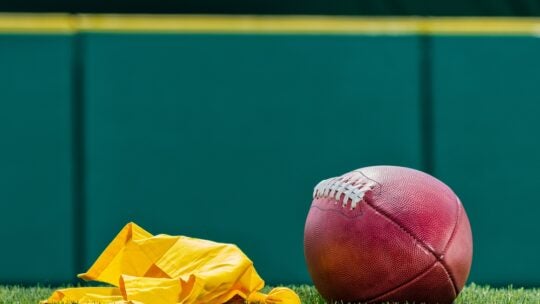
PR roundup covers how a small football cleat startup converted an NFL uniform violation into one of the fall’s best earned media moments, what Martha Stewart’s Halloween crisis reveals about the difference between a statement and an apology and new research showing that the press release isn’t dead—it’s becoming a long-lived source for AI answers.
How an NFL Fine Turned Into Caddix’s Best PR Campaign
What happened: Caddix founder Jack Rasmussen told ESPN he knew the fine was coming. The Baltimore-based startup—which makes moveable cleats designed to reduce injury risk—had been approved as a non-licensed NFL footwear company earlier this year, meaning players could wear the cleats on the field, but the logo couldn’t be visible. When Chicago Bears quarterback Caleb Williams started wearing Caddix, logo displayed, it was only a matter of time.
The NFL fined Williams $11,941 for an “unauthorized logo” in Week 6, then $23,882 for the same in Week 7—a total of $35,823, per the Chicago Sun-Times. Caddix and company investor and NFL quarterback Joe Flacco quickly announced they would cover the fines. The brand then put up billboards around Chicago reading “Caleb, we’ll pick up the tab,” per Inc. By the time Williams wore unbranded matte black cleats Monday night against Seattle—saying he wanted to “calm things down” for his team—the story had already done enormous work for a brand most fans had never heard of three weeks earlier.
The numbers tell the story. Caddix now has over 100 professional athletes wearing its cleats, including roughly 50 NFL players, per Forbes. The company has surpassed $3 million in lifetime sales, despite launching its first retail cleats just this summer. Williams came to the brand not through a traditional endorsement deal—he has none with any brand—but through his longtime quarterbacks coach, who connected him with Rasmussen after Williams’ father asked about alternatives that might protect his feet, ankles and knees, per ESPN.
When Williams wore the logo-free version Monday night, Caddix’s X account posted simply: “No logo necessary.”
Communication takeaways: The story is a great example of turning a constraint into a campaign. By covering Williams’ fines and advertising that decision on Chicago billboards, Caddix converted a league penalty into a credible, authentic gesture and a news cycle simultaneously. As Rasmussen told WBAL-TV, making the offer was a marketing strategy—but it also felt like “the right thing to do.”
Michelle Kafka, COO and Account Director at Kafka Media Group, works with Caddix as a client, and says brand communicators in these situations have to remember to stay focused on the message, and not put words in an athlete or celebrity’s mouth.
“It’s an interesting situation when a well-known figure purchases and wears a brand on their own without the brand payment or contract,” Kafka says. “With the Caddix story, we kept the focus on what the product is, what it does and what direct feedback we’ve had from Caleb.
Kafka says every time reporters and commenters asked questions like “Why doesn’t he just tape them?” and “Why would he wear these cleats if you’re not paying him?” the company continually points back to the fact that he bought them and chooses to wear them on his own.
Listening to the client and stating the facts can make for a powerful story in itself.
Martha Stewart’s Halloween Costume Was a Two-Apology Crisis
What happened: Mogul Martha Stewart posted a photo to Instagram on Halloween dressed as a homeless person—wearing distressed jeans, smeared makeup and a sign reading “I am hungry, help me!!” CNN reported this post as part of a carousel also promoting her candle collection. The Stewart camp quickly deleted the post after backlash, with critics calling it “out of touch,” “tone-deaf” and “dystopian.”
Stewart’s initial response made things worse. She told Page Six she was “distressed” that the costume had offended people and framed it as an awareness effort.
“My Halloween costume yesterday was intended to bring more awareness to the very serious subject of homelessness,” Stewart said.
In comments on other Instagram posts, she doubled down, writing, “My costume was designed to bring the homeless and the hungry to everyone’s mind and boy it certainly did!!!”
By Sunday, Stewart issued a second statement—this one an actual apology.
“It’s hard to admit when you’ve really screwed up,” she wrote on Instagram. “My earlier statement didn’t go far enough. I know many people are economically struggling. Wearing a costume like I did was insensitive and not funny. I am very sorry.”
Communication takeaways: The episode is a two-part study in what not to do. The first statement—framing the costume as awareness-raising while expressing distress that others were offended rather than taking responsibility—is a textbook example of a non-apology. It tends to extend and deepen a controversy rather than resolve it.
The second statement, while belated, did what the first should have: acknowledged the mistake directly and without deflection. The added detail that the original post was embedded in a candle promotion made the awareness framing harder to accept. When a brand moment and a social message are bundled together, audiences will notice—and judge accordingly.
Amore Philip, Founder and Communications Advisor at Apples & Oranges Public Relations, says the second statement worked because it did the one thing an apology has to do: naming the mistake and owning it.
“'I really screwed up'” works because it sounds like Martha, not like a legal team,” Philip says. “Speed matters less than direction. A fast apology aimed at the wrong target costs you a second news cycle."
Philip also notes the lessons a comms team should take from this if helping manage a founder’s personal feed.
"When the founder is the brand, the personal feed is a corporate channel,” Philip says.
She advises that comms teams need two things in place before anything goes wrong: a simple pre-post check for anything that touches a product, a holiday or a sensitive group, and an apology framework the founder has already seen.
“The goal is not to take the founder's voice away,” she says. “It is to make sure the first response is the right one, so there is no need for a second."
New Study: Press Releases With Descriptive Subheadings Get 61% More AI Citations
What happened: A new study from Notified offers a detailed look at what makes a press release visible in AI-generated answers. “Written for People, Read by Machines” analyzed more than 25,000 releases and nearly 1 million AI citations to pinpoint the content characteristics behind stronger citation performance across leading AI systems.
The findings are organized around four pillars—Structure, Originality, Authority and Recency—and key points include:
- Structure: Press releases with descriptive subheadings like “Key Findings” or “Financial Highlights” received 61% more AI citations; those with high fact density earned 29–33% more.
- Originality: Releases built on proprietary research earned no citation lift unless they stated their novelty plainly—announcements using “first-of-its-kind” language garnered 60% more citations.
- Authority: Releases linking to a company’s own website received 57% more citations; including a generic corporate media email (media@company.com) was associated with 38% more citations, while naming only an individual contact was associated with 12% fewer.
- Recency: More than 56% of citations from ChatGPT and Claude arrived after week one—and both models mostly cited the version they crawled first.
Communication takeaways: That last finding may be the most important for communicators to internalize. A press release isn’t just an announcement that lives for a news cycle—it’s a source AI models keep returning to for weeks. Getting the structure, facts and messaging right before distribution matters more than most PR teams currently plan for.
“What surprised us in this study was the staying power releases have,” says Erik Carlson, CEO of Notified. “AI systems don’t just cite a release once and move on. They keep citing it, again and again, for weeks across multiple models. A press release isn’t just an announcement—it’s a source for AI answers.”
Nicole Schuman is Managing Editor at PRNEWS.