

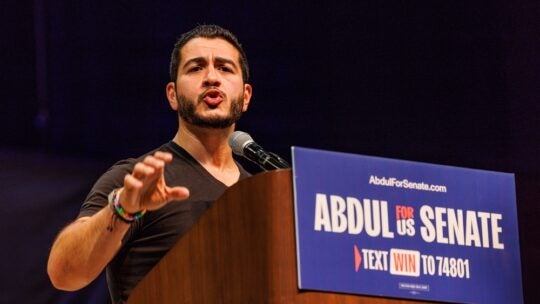
Political consultants have spent decades coaching candidates to soften their language, broaden their appeal and avoid anything that might make voters uncomfortable. Michigan Sen.-elect Abdul El-Sayed has taken a different approach.
Fresh from his electoral victory in Michigan, the Columbia University-trained medical doctor, Oxford-educated public health scholar and Democratic politician built a communications style that is direct, often confrontational and light on the diplomatic cushioning common in political messaging.
His style builds on a shift in political messaging that President Donald Trump helped popularize: rejecting carefully calibrated language for blunt, unfiltered expression that audiences can read as more authentic. But where Trump’s appeal has often rested on provocation, El-Sayed pairs bluntness with policy expertise, unapologetic candor and hard numbers.
El-Sayed's directness has not come at the expense of dialogue. He engages, debates and challenges ideas while staying firm on his values. Supporters see that combination as authenticity.
His approach offers lessons for communicators, strategists and brand builders on credibility, evidence-backed messaging and shifting political audience expectations. Here are six worth examining.
-
Stop Treating Identity as a Liability to be Managed
In an earlier PRNEWS analysis of Zohran Mamdani's mayoral campaign, it's argued that one of its most important communications lessons was to "let identity inform, not limit." Mamdani demonstrated how faith, cultural heritage and lived experience could become strategic strengths, helping build connections across communities without requiring a candidate to diminish who they are.
El-Sayed offers another example of this principle, although his approach is distinctly his own.
Minority politicians, particularly Muslims, have historically faced additional scrutiny around religion, ethnicity, loyalty and belonging in American political life.
Beyond articulating policies and demonstrating competence, candidates may find themselves expected to reassure audiences about aspects of their identity that would rarely be questioned in other politicians. At an October 2026 town hall an attendee asked El-Sayed, “Will you disavow the Muslim Brotherhood?” He replied, “Sure, yeah, absolutely,” then asked why a Muslim candidate was being made to answer that at all.
Be Muslim, but not too visibly Muslim. Be proud of your heritage, but don't make anyone uncomfortable. Challenge prejudice, but do so diplomatically.
These expectations can influence how candidates present themselves, which subjects they address and how they respond to difficult questions. Over time, the process of accommodation can become almost instinctive.
El-Sayed's public identity offers a different model.
His Muslim faith and Egyptian heritage are visible parts of his political biography. Rather than treating them as details requiring careful explanation or qualification, he presents them as part of who he is.
A candidate who continually attempts to reassure audiences about his identity risks allowing others to define the terms on which he is considered acceptable.
El-Sayed publicly rejected those terms. Rather than continually seeking permission to belong, he treats his belonging as fact.
For communicators, the lesson extends well beyond politics. The pressure to adapt to an audience can sometimes become an exercise in removing the very qualities that distinguish a leader.
The takeaway: Let identity inform, not limit. Effective positioning should make someone more clearly understood, not less recognizable. Adapting how we communicate should not automatically mean diluting who we are.
-
Challenge the Premise, not Just the Question
Political media training typically emphasizes composure, message discipline and the ability to redirect difficult questions.
Remain calm. Avoid defensiveness. Bridge back to your key messages. Find common ground.
These techniques have considerable value, but they can also encourage candidates to accept the framing of questions that deserve to be challenged.
This becomes particularly relevant when questions involve religion, ethnicity or identity.
El-Sayed's willingness to engage directly with identity-related scrutiny offers an opportunity to examine how candidates can challenge those assumptions without abandoning the substance of the conversation. For example, in an October 2026 Fox News interview, host Bret Baier raised the Muslim Brotherhood allegations against El-Sayed, and El-Sayed cut in before the question was finished, telling Baier he was asking it “to raise a question about whether or not I have dual loyalty.” He stated that he had never been a member of the group and never would be, and that his loyalty would be to the Constitution. Having named the premise, he still answered the question.
The communications principle extends well beyond politics.
Leaders and organizations are frequently asked questions built around inaccurate assumptions, misleading comparisons or incomplete information.
The instinct to answer immediately can inadvertently legitimize the framing.
Sometimes the more effective response is to identify the assumption, explain why it is flawed and then address the underlying issue.
There is also a distinction between confrontation and defensiveness.
The former can demonstrate conviction and control of the conversation. The latter can reinforce the impression that the person being questioned has something to explain or justify.
Of course, confrontation carries risks. What one audience interprets as courage, another may perceive as hostility.
The effectiveness of this approach therefore depends on whether the confrontation illuminates something important, whether the argument is defensible and whether audiences understand what is being challenged and why.
The takeaway: Not every question should be answered on the questioner's terms. Recognizing and challenging a false premise can be more effective than delivering a perfectly rehearsed response to the wrong question.
-
Don't Manufacture Relatability
There is something revealing about El-Sayed's public presentation.
The fitted black T-shirts and jeans uniform that had The New York Times talking. The Taylor Swift girl dad bracelets made by his daughters. The affection for his family. The informal appearance that departs from the conventional image of a political candidate.
These details contribute to a public persona that can read as comfortable and comparatively uncontrived.
That matters because authenticity has become one of the most manufactured qualities in modern communications.
Political campaigns routinely invest in carefully staged moments designed to demonstrate relatability: the rolled-up sleeves, the casual conversation, the strategically placed family photograph and the supposedly spontaneous behind-the-scenes video.
Entire communications strategies are built around creating the impression that no communications strategy exists.
What makes El-Sayed's presentation interesting is that these personal details appear incidental to who he is, rather than the organizing principle of an elaborate relatability campaign.
It is difficult to establish from the outside which aspects of any politician's presentation are spontaneous and which are strategically considered. But audiences respond to what they perceive, and the impression of someone comfortable in their own skin can be more persuasive than an elaborate effort to appear approachable.
Communicators spend considerable time helping leaders become more relatable. Sometimes that involves encouraging them to reveal personal details, share informal moments or adopt a less corporate tone.
But relatability is not necessarily something that needs to be created.
Sometimes it is simply what remains when the layers of excessive image management are removed.
The takeaway: Authenticity is often most persuasive when it appears incidental rather than deliberately performed. Don't manufacture personality. Allow the details that make someone recognizably human to remain visible.
-
Accept that Authenticity will not Appeal to Everyone
There is a paradox at the heart of contemporary political communications.
Candidates are constantly told to be authentic while simultaneously being advised to modify almost every aspect of their presentation to appeal to the widest possible audience.
Be yourself, but be a version of yourself that everyone can comfortably accept.
For politicians whose identities are already subject to scrutiny, that can become a difficult balancing act.
El-Sayed's communications approach raises an important question: what if the pursuit of universal palatability is itself counterproductive?
When politicians continually soften their language, qualify their convictions and adjust their presentation to avoid alienating anyone, they risk communicating very little about what they actually believe.
And when every position has been carefully focus-grouped, every phrase tested and every potentially uncomfortable edge smoothed away, audiences may struggle to distinguish genuine conviction from strategic calculation.
The refusal to be universally liked can therefore become a source of credibility.
But there are limits.
Authenticity is not inherently persuasive. Being unapologetically oneself does not guarantee good judgment, sound policy or electoral success. Nor does the willingness to offend necessarily demonstrate courage.
A communications style that generates enthusiastic engagement among existing supporters may not necessarily persuade those outside an established political constituency.
These distinctions matter, particularly for communications professionals who are increasingly inclined to celebrate anything that appears to disrupt established conventions.
The objective should not be to replace conventional political polish with performative confrontation. It should be to recognize that credibility can sometimes require a willingness to disappoint, challenge or alienate parts of an audience.
This is particularly relevant for corporate leaders, who often face pressure to communicate in language so carefully managed that their personal convictions become almost impossible to discern.
The takeaway: Credibility and universal approval are not the same thing. A coherent, defensible position may be more valuable over time than a message designed to offend no one.
-
Strip Away the rhetoric, but Keep the Substance
One of the features of El-Sayed's communications approach is his willingness to dispense with conventional political euphemisms.
His directness is frequently accompanied by detailed policy arguments, an emphasis on evidence and an insistence on explaining the consequences of political decisions.
Conventional political messaging is often built around language designed to minimize disagreement. Candidates speak about strengthening communities, creating opportunities, protecting families and building a better future. These are unobjectionable aspirations. They are also so familiar that they can become almost meaningless.
El-Sayed's public communication frequently centers on the consequences of political decisions, particularly in healthcare and economic policy.
His earlier advocacy for Medicare for All and his work on healthcare policy illustrate how he connects broad political positions to questions of access, affordability and the structure of the healthcare system.
There is a distinction between being provocative for the sake of provocation and being blunt because you believe the facts warrant it. The former relies on the emotional impact of saying something outrageous. The latter seeks to make the underlying reality difficult to ignore. For communicators, that distinction matters enormously.
Direct language is most effective when it clarifies an argument rather than merely making it louder.
The takeaway: Strip away unnecessary rhetoric but make sure there is substance underneath. Plain speaking is powerful when it helps audiences understand what is at stake, not simply when it generates a reaction.
-
Conviction Doesn't Require Closing the Conversation
Another aspect of El-Sayed's communication style is the relationship between conviction and dialogue.
Political communication increasingly rewards certainty. Candidates are expected to take positions, defend them forcefully and avoid anything that might be interpreted as hesitation or inconsistency. Changing one's mind can be portrayed as weakness, while acknowledging a competing argument risks being labelled a concession.
Yet there is an important difference between knowing what you stand for and believing you have nothing left to learn.
El-Sayed's willingness to participate in extended conversations outside conventional Democratic media spaces offers an interesting example. His Fox News appearances on placed him before an audience that was not necessarily predisposed to share his political views, in a format that allowed for sustained discussion rather than tightly controlled campaign messaging.
The appearances demonstrate a willingness to engage beyond his natural constituency, although it should not be mistaken for evidence that he changed his position in response to disagreement.
For communicators, this presents a useful challenge to conventional media training.
We frequently encourage leaders to remain disciplined, repeat their key messages and avoid being drawn into unfamiliar territory. While these techniques have their place, excessive message control can make even knowledgeable leaders appear unwilling to engage with ideas beyond their prepared positions.
A willingness to listen, acknowledge complexity and explain one's reasoning can communicate confidence just as effectively as a forceful declaration. It also creates room for something increasingly rare in public discourse: the possibility of disagreement without immediate dismissal.
The takeaway: Conviction and intellectual openness are not mutually exclusive. Strong leaders can remain anchored in their values while engaging seriously with perspectives that challenge their thinking. The objective is to demonstrate confidence in one's principles without creating the impression that every opinion is beyond examination.
The Bigger Communications Lesson
El-Sayed's communication style reflects a broader shift in what audiences increasingly recognize as credible political leadership.
His bluntness, policy expertise, unapologetic embrace of his identity and willingness to engage in difficult conversations contribute to a public persona supporters see recognizably his own. There is consistency between the person, his principles and the way he communicates them.
For communications professionals, this raises an uncomfortable question: in our efforts to make leaders more persuasive, accessible and broadly acceptable, how often do we end up removing precisely the qualities that make them compelling?
There is, of course, a place for message discipline, audience awareness and strategic positioning. Effective communication requires all three. But strategy should sharpen a person's ability to express what they believe, rather than systematically smooth away every opinion, characteristic or conviction that might provoke disagreement.
Authenticity should not be confused with rigidity. There should be room for debate, intellectual curiosity and openness to other perspectives without abandoning the values that guide one's decisions.
In an era when authenticity itself has become something to be carefully manufactured, perhaps the more radical proposition is to stop managing every aspect of who someone is and let the person, their convictions and their arguments speak for themselves.
Selina Rashid is Founder & CEO at Lotus Client Management & Public Relations.