

PR roundup covers how Lucky Charms turned a sorority trend into a multigenerational content moment, what new data on AI search visibility means for communicators thinking about GEO, and why eos's U.S. Open activation is a case study in letting community lead the way.
Lucky Charms Goes Deep on RushTok
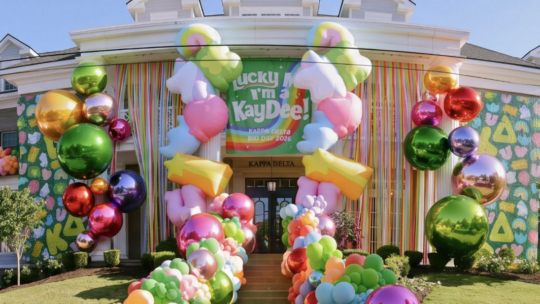
What happened: Every August, #RushTok takes over social media as college women document their sorority recruitment journeys, culminating in Bid Day—the moment new members find out which house they've been accepted into. This year, the University of Arkansas's Kappa Delta chapter took the spotlight, with a Lucky Charms-themed Bid Day that turned into a full General Mills brand activation: marshmallow balloon installations, DIY charm bracelets, custom merchandise and photo booths, all branded in the cereal's signature rainbow colors.
View this post on Instagram
The partnership didn't come out of nowhere. The "Lucky Me" sorority trend had already been circulating on RushTok before General Mills stepped in. The brand spotted a natural cultural fit and moved to own it.
"We saw the 'Lucky Me' sentiment already taking off on RushTok and knew Lucky Charms could bring a little of its signature whimsy to the moment in a way that felt natural and fun," says Megan Brooks, Business Unit Director for Family Favorite Cereals at General Mills. "By going deep with one Kappa Delta community and empowering members to make the brand their own, we've seen the content travel far beyond Bid Day—reaching millions of people across generations."
Communication takeaways: The Lucky Charms play is worth studying as a model for community-first brand activations. Rather than broad sponsorship across multiple schools, General Mills went deep with one chapter—and let organic content do the rest. The result was a campaign that reached well beyond Arkansas's Greek Life, connecting with audiences across demographics who had no connection to Bid Day at all. Going narrow to go wide can be a useful strategy.
Emily Blair Marcus, CEO and Founder, Emily Blair Media, says the concept of brands collaborating with college students is more than a trend—it's become big business. And that goes beyond NILs.
“I believe this marketing approach will continue to expand, paralleling the growth of collegiate influencers,” Blair Marcus says. “This even extends far beyond Greek life as many college campuses have their own REACH chapters, which operate as a first-step social media management organization to represent prominent student creators and influencers with growing platforms.”
Blair Marcus says her clients are also excited by and interested in these partnership opportunities because many students are longtime customers and organic supporters. However, she does note, when considering a partnership with college students, it's important to ensure that the organization shares the brand’s values, pillars and points of view.
“Do the research beyond just understanding the aesthetic look and feel of the organization, because while it's attractive to partner with groups that emulate the vibe you're hoping to attract, at the end of the day, college students are young and cancel culture is rampant,” she says. “These students are now representing you and your company, beyond just a glossy Bid Day event so do your homework.”
Which Back-to-School Brands Are Winning AI Search?
What happened: As kids go back to school, families are increasingly turning to ChatGPT, Claude and Gemini for product recommendations. The Pollack Group's inaugural Brand Visibility Index offers some early data on what brands are appearing most often in AI answers. Analyzing 335 AI-generated answers to common back-to-school shopping questions across six major retailers, the report found a striking visibility gap—Target and IKEA each appeared in roughly 30% of AI responses, while Amazon, the next-highest performer, appeared in just 8.7%.
What’s driving these results? Key findings show:
- IKEA's dedicated dorm essentials page was cited in 27% of responses—suggesting purposeful content outperforms broad catalog pages in AI search
- Reddit appeared in 32% of AI responses, YouTube in 19% and Instagram in 16% showing that AI search also likes social and community content
- Earned media also played a role, with outlets including NBC, Forbes and Teen Vogue appearing among AI-cited sources
- IKEA ranked highest in mention position, appearing between the second and third brand mentioned on average
Communication takeaways: The findings reinforce that earned media, social presence and purposeful content aren't just PR and marketing tactics—they're increasingly the items that determine whether a brand gets recommended by AI at all. Scale alone doesn't guarantee visibility. Relevance does.
Nicole Paleologus, Senior Managing Director at Next PR, says she immediately gravitated toward the Reddit findings, as she still sees it as an underused brand platform because of its influence on AI visibility.
“The community-driven discussions carry significant weight, especially because brands can’t approach the platform with the same marketing mindset they would a whitepaper,” Paleologus says. “Its presence in 32% of the study’s responses shows that brands need to think beyond traditional media and owned content when considering how they show up in AI searches.”
She also notes that even with the recent news of Reddit’s share of ChatGPT citations dropping, that actually reinforces the fact that AI visibility is constantly evolving, and brands need to build a presence across multiple channels rather than relying on any one source.
“Reddit should have a seat at the table alongside earned media, owned content and other digital channels as part of a broader strategy,” she says.
Ayan’s Aces and eos: Community-First Engagement Through Tennis
What happened: In New York City and want to learn tennis? Grab a racket!
To usher in U.S. Open season, personal care brand eos is taking a different approach to the cultural moment. Rather than traditional tournament sponsorship or advertising plays, eos partnered with professional tennis player Ayan Broomfield and her Ayan's Aces initiative to host a day of tennis clinics, open play and community-building for 100 women of color in NYC on Aug. 22.
The event—called The eos Smooth Set: Ayan's Aces Tennis Clinics—pairs on-court programming with off-court brand experiences: an eos scent bar, a product bedazzling station, snacks and time with Broomfield herself.
The activation is deliberately designed around community engagement, access and representation rather than reach and impressions. It uses the U.S. Open as a platform to create entry points into tennis for an underrepresented audience rather than simply riding the tournament's end-of-summer zeitgeist.
View this post on Instagram
Communication takeaways: The eos model is worth noting alongside the Lucky Charms and Gen Z fandom data from earlier in this roundup. The theme across all three: brands that go deep with specific communities—rather than broad with general audiences—tend to generate the kind of engagement and organic storytelling that wider campaigns can't manufacture. The partnership works because it's built around something Broomfield's community already cares about, with the brand playing a supporting role.
Carmella Glover, President and CEO of the Diversity Action Alliance, says what makes the partnership so brilliant is that the brand is expressing its values through intentional action rather than a declaration of commitment.
“By supporting an established advocate for women of color, eos lends its platform to credible community leadership while creating tangible access to a sport in which visibility for athletes of color—i.e., Serena and Venus Williams, Coco Gauff, Naomi Osaka—has not yet translated into broad representation,” Glover says.
Glover also notes that this is stakeholder relationship-building at its best.
“Ayan and her initiative remain at the center, while eos creates a memorable brand experience that invites women of color to participate, connect, discover products and offer feedback,” she says. “The product integration is additive and strategic because the brand is boldly investing in and engaging with the community without emulating, fetishizing or exploiting its culture.”
Glover also says the partnership and activation will resonate with women of color, who are some of the most highly engaged beauty consumers, and will now associate eos with “getting it,” as they expect brands to demonstrate cultural fluency through behavior.
“If you know anything about women of color, they want to stay hydrated, moisturized, and unbothered, which is very on brand for eos,” she says. “The whole activation strategy is compelling and smart PR, cutting across generations and identities in a non-polarizing yet very clearly defined way.”
Nicole Schuman is Managing Editor at PRNEWS.