

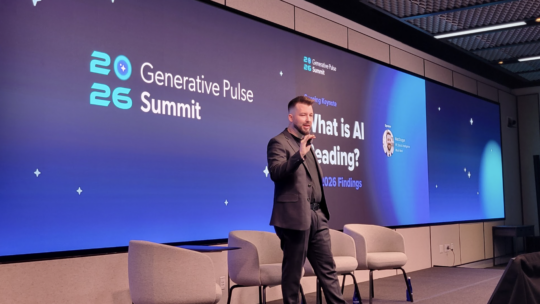
The second annual Muck Rack Generative Pulse Summit opened with the release of the company's newest "What Is AI Reading?" report on Oct. 28. The top finding? AI cites earned media 84% of the time, and 22% is journalism specifically, down from 27% in May 2026.
The overall theme of the day revealed that communicators can't control what AI says about their brands, but they can influence what those citations are built from. PRNEWS found five takeaways from the Summit, with some guidance for communicators on how to embrace each.
1. Think media food chain, not single press release.
Matt Dzugan, VP, Data & Intelligence at Muck Rack, opened with a live example of PR within the GEO food chain. Claude cited Muck Rack's Wikipedia page, which cited a trade article, which featured information from a Muck Rack press release. AI search results never cited the release, yet its message carried through.
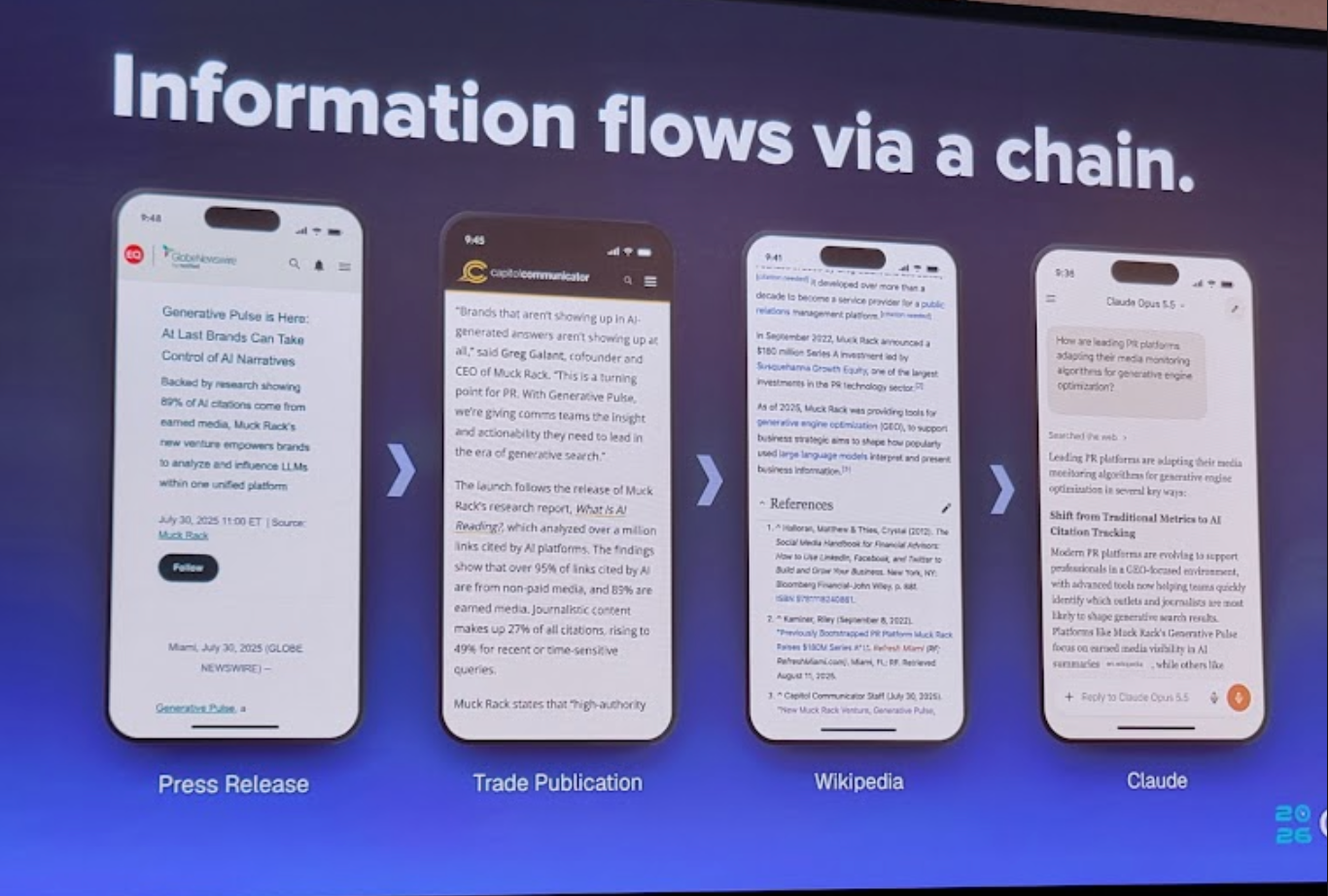
Dzugan’s point: AI answers come from an information ecosystem. Wikipedia is the top-cited source on Claude and a top-10 source on Perplexity, Gemini and ChatGPT. And 60% of reference links on S&P 500 companies' Wikipedia pages are third-party editorial, not company websites. Dzugan expects comms teams to pay far more attention to Wikipedia in the coming years.
"We as communicators, we're at the bottom of the food chain," Dzugan said. "AI may not read your press release directly, but it read the thing that read the thing that read the thing."
Takeaway: Map where a story travels after it publishes (wires, trades, Wikipedia, Reddit).
2. Communicators can influence AI answers, not control them.
Ellen Murphy, EVP at Syneos Health, told attendees comms pros are in a "golden age" of influence over AI models that may not last, especially as paid placements roll out in more of them.
"Control is a tough word," Murphy said. "I do think we have influence, but not control."
Part of the challenge: Engines behave differently and keep changing. Dzugan's research found ChatGPT leans on favorite sources, Perplexity cites the widest range, Google Gemini favors brand sites and Claude prefers academic and statistical sites. Ask ChatGPT the same question twice, and most of the cited links will differ. In Muck Rack's data, Associated Press citations fell off in July before partly returning.
Michael Lamp, Chief Digital & Transformation Officer at HUNTER, advised against chasing any one engine.
"Measuring once is not measurement," Lamp said. “There’s a new PR pipeline. Did it become an answer, and how long did it stay an answer? Think about cadence.”
Lamp also urged tracking where a brand lands in an answer, not just whether it appears. A brand that's always in the bottom third isn't getting a recommendation.
Takeaway: Pick a handful of key prompts, run them repeatedly across several models and track the trend over time.
3. Fix your own house first.
Lamp called one AI risk "friendly fire": Company websites keep feeding AI information that's out of date.
"It was once true, and we put it there, but now we've sort of ceded our own ability to tell a modern story about ourselves," Lamp said.
The panelists offered familiar, yet essential fixes.
"I think it's the era of the brand newsroom again," Murphy said, urging FAQs, Q&As, fact sheets and executive interview transcripts. "I'm going to FAQ everything now."
Margot Edelman, Global Tech Practice Lead at Edelman, noted that LLMs do pick up press releases, so pack them with the facts you want cited.
“Having all the information in a press release that you want in an LLM is very helpful,” Edelman said. “So what's old is new again.”
Edelman also noted the importance, particularly for global brands, of checking your citations not just over time, but looking at results per location, which can fluctuate.
“Think about your brand globally,” she said. “How is it perceived in Germany versus the U.S.? How are the answers appearing there? And can you measure sort of in a dynamic way over time through multiple LLMs?”
And write clearly. Senka Hadzimuratovic, Head of Communications at Lovable, said engines, personal agents and people all respond to the same thing. "They all reward clarity," she said.
Takeaway: Audit your owned content for stale facts, set a refresh cadence and rebuild the online newsroom with structured, fact-rich Q&As.
4. When AI gets it wrong, stay calm and move fast.
A live crisis exercise put Molly McPherson, crisis communications experts and host of “The PR Breakdown” and Jesse Dwyer, Head of Communications at Perplexity, on stage with a fictional scenario: AI invents a CEO quote claiming remote employees are less committed.
Both advised investigating quietly before issuing a statement.
"Every crisis begins in the house," she said, so check internal sentiment. On receiving a reporter’s inquiry, she added: "Being silent is different than being quiet." Keep talking to the journalist while you gather facts.
Dwyer cautioned against arguing over the quote, and instead re-frame the conversation around the CEO’s actual comments.
"You can't fight the frame, but you can set public opinion," Dwyer said, recommending fresh, quotable context for reporters instead.
Speed matters, too. "Start with a holding statement ... Just say we're looking into it," Hadzimuratovic said in her session, while keeping crisis protocols (who decides, how fast) firm.
Takeaway: Update your playbook with AI monitoring and name an AI crisis owner.
5. AI raises the premium on human skills.
Emma Cosgrove, Editorial Director of AI Innovation at Business Insider, said AI is powerful in the "first mile" of reporting, but "the last mile is exactly the same: fact checking, editing, getting the story on the site." Her ask of comms pros: Offer the human side.
"You have to be willing to be a whole human because that is a story that people want to read right now," Cosgrove said.
The same theme ran throughout several panels. Alem Tedeneke, Senior Manager at Accenture, worried that automating grunt work like media clipping removes the learning that came with it.
"I also cut out articles out of newspapers and stuck it on a page and collated and stapled those reports that nobody read or looked at,” Tedeneke said. “But I learned a lot. Learned people's speech, what translated, how reporters like to get their information…and I'm not saying that we shouldn't use the tools that we have now to take away some of that manual work. My worry is that the learning is going with it, right? So where are the ways that we are incorporating that learning when we're having new staff?" Tedeneke said.
Elana Widmann, Corporate and Executive Communications at OpenAI, described a task of making the team "go line by line" through an event invite list, asking why each person was invited and what they'd pitch.
"The higher the EQ, the better the comms," Widmann said.
Tedeneke also cautioned against hiring for technical skills alone.
"I think GEO is a capability, visibility is an outcome," Tedeneke said.
Alyssa Bernstein, SVP of Corporate Communications at TelevisaUnivision, said having a point of view is what's missing from much of today's communications.
Takeaway: Pitch editors the human story, coach juniors to defend their choices, and use AI as a sounding board rather than for first drafts.
Nicole Schuman is Managing Editor at PRNEWS.