

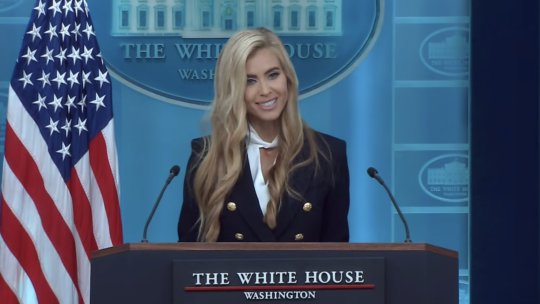
This week’s roundup covers what Katie Zacharia’s first White House briefing reveals about the stakes of introducing any new spokesperson, new Sprout Social research showing how much social media is shaping voter opinions ahead of the midterms and why Meltwater’s Kim Cattrall campaign is a smart piece of B2B brand strategy worth studying.
A New Press Secretary’s First Briefing Raises Questions
What happened: Katie Zacharia, a conservative commentator and former senior communications adviser for Trump Media & Technology Group, held her first White House press briefing Oct. 13—and the reviews, including from inside the White House itself, were not kind.
According to NBC News, the briefing lasted roughly 14 minutes, and Zacharia spent more than half of that time reading slowly and intermittently from prepared remarks touting the president’s record. She then took questions from just three outlets—Breitbart, Fox News and the Daily Mail. CNN reported that several White House advisers described the performance as “brutal,” “unusual,” “awkward” and “stilted,” with one saying it was “unlikely to satisfy” Trump.
Zacharia did break one piece of news: in response to a Daily Mail question, she revealed that the administration had asked Kimberly Guilfoyle, the U.S. ambassador to Greece, to resign following misconduct allegations.
Questions also surfaced about her credentials. NPR asked the White House to clarify whether Zacharia holds an active U.S. law license; she responded that she “practiced international transaction law, with all the appropriate credentials”—a statement that didn’t fully resolve the question.
Erin Seidler, Partner at Elevate Strategies, says this is a PR issue for the White House, not just Zacharia.
“What struck me was the decision to put her at the podium less than 24 hours after she started the job,” Seidler says. “Perhaps this is because we are a month from the midterms and they needed someone in place, but Kayleigh McEnany, by comparison, said she spent two weeks on the job before taking the podium. It was clear she wasn’t adequately prepared.”
Communication takeaways: For communicators, the briefing is worth analyzing on itself. The press secretary role is one of the most visible communications jobs in the world—a daily exercise in message discipline, credibility and media relations under pressure. A first briefing sets the tone.
PR professionals watching Zacharia’s debut had plenty to say—and their observations add up to a useful set of best practices for introducing any new spokesperson or leader.
Overall, experts believe that preparation and media training are not the same thing.
“Practice doesn’t make perfect—practice makes permanent,” says Lizzy Harris, CEO of The Colab. “Rehearsing only helps if you’re preparing for the questions and pushback you’ll actually face.”
Kate Jones, a communications consultant and former TV journalist, agrees, noting the briefing was “a perfect example of why spokespeople need to know messaging inside out—so that when there are distractions, like nerves, they can fall back on it with less thought and effort.”
Jared Meade, Founder of Rayne Strategy Group, raised a point that resonates beyond the White House.
“It made me wonder whether she’ll have enough command of the topics/issues to respond thoughtfully without relying on a script,” Meade says. “There is a big difference between being prepared with talking points and being prepared to engage with reporters.”
Lindsay Wyskowski, Associate Vice President, Consumer at Identity, noted that the briefing showed how important the PR function is, particularly before the public.
“It really demonstrated the value of skill, confidence and readiness that so many professional communicators bring to the job every day—not everyone is cut out to be a spokesperson,” Wyskowski says.
The consensus among PR pros: first impressions in high-stakes communications roles carry enormous weight, and no amount of loyalty substitutes for the kind of message delivery that only comes from genuine preparation—and knowing your audience.
New Sprout Social Research: Social Media Is a Voting Booth Influencer
What happened: With the midterms approaching, new research from Sprout Social’s latest Pulse Survey finds that social media has moved well beyond awareness-building for political candidates—it’s actively changing minds.
Fifty-five percent of Americans say a social media post has informed or changed their opinion on who to vote for, with 27% saying a post changed their view outright. Among Gen Z, that number jumps to 79%, with nearly half saying a post changed their opinion entirely.
Key findings:
- Social is now the top news source for younger voters: while TV leads overall for midterm election news, social media ranks first among Gen Z and Millennials, and more than 1 in 5 plan to increase their social media use as Election Day approaches
- Candidate perception is shaped online: 33% of Americans—and 42% of Millennials—say politicians seem more approachable when they post about their policies; 50% of Americans and 70% of Gen Z follow at least one politician on social
- Gen Z is nearly twice as likely as the general population to rely on creators and influencers for election information
- AI deepfakes are a growing concern: 80% of Americans worry about encountering AI-generated deepfakes of candidates, with 40% extremely concerned; finding out a political ad is AI-generated makes 35% skeptical of all political ads
Communication takeaways: For brands, the survey offers a clear message for navigating election season: stay the course. Americans are twice as likely to want companies to keep posting regular content while steering clear of politics (23%) as they are to want brands to go dark until the election passes (11%). Consistency and authenticity are what audiences want from brands, even when the broader news cycle is dominated by politics.
Abigail Hart, Public Relations Manager at Sprout Social, says even if you are not working in politics, your audience is still forming opinions about you on social—whether you are part of the conversation or not—so making social listening a priority is essential.
Hart says it’s worth setting up monitoring around your brand, competitors and topics your audience cares about, not just your own mentions.
“If you’re not catching those conversations in real time, you’re missing chances to join the conversation, correct misinformation or get ahead of sentiment shifts,” she says.
Hart also notes what brands can learn from political messaging on social media.
“The research found that politicians who post directly about their policies come across as more approachable, especially to Millennials,” she says. “That’s a useful parallel for brands: when leadership shows up personally on social rather than only speaking through brand accounts, it can make the organization feel more human and accessible.”
Samantha Jones Returns to PR?
What happened: PRNEWS rarely writes about anniversaries, but when we saw this campaign, we couldn’t turn away.
Meltwater is marking its 25th anniversary with a brand campaign that leans hard into both nostalgia and the present moment. “Intelligence is Always in Style” stars actress Kim Cattrall as a fictional executive who is always one step ahead—navigating brand reputation, tracking conversations, monitoring LLMs and spotting crises before they escalate. Her secret weapon, of course, is Meltwater.
The campaign is a short-film series set in New York City with a look that nods to glossy magazine spreads and print newspapers—a callback to the media environment in 2001, when Samantha Jones, Kim Cattrall’s character in “Sex and the City,” flourished in the PR industry.
Cattrall herself noted that her front-row seat to the PR industry throughout her career made the campaign feel personal: “That’s the shift this campaign is about, and why I was excited to bring this character to life.”
Communication takeaways: The campaign is worth noting as a piece of B2B brand strategy. Meltwater sells intelligence software to PR and communications teams—not a traditionally glamorous pitch. Using a culturally resonant celebrity, a content series format and a fashion-inflected aesthetic to showcase that audience as powerful, savvy executives is a smart play. The message underneath: the job of the modern communicator has changed, and the tools should match.
“It felt like the right moment to say something bold about where the industry is headed and what it takes to be successful today,” says Alexandra Bjertnæs, Chief Strategy Officer at Meltwater. “We didn’t want to just look back; we wanted to show what this industry demands of its leaders in the current media landscape.”
Priscila Martinez, Founder and CEO of The Brand Agency, says Cattrall is a smart fit, as her most famous role was as a PR maven. Martinez says there are a few key factors that should be weighed before exploring a campaign with a celebrity.
“Number one is resonance,” Martinez says. “Does your key audience know who the celebrity is? Would the celebrity’s participation make your intended audience more or less likely to engage with your brand?”
One thing we are curious about? Whether Samantha Jones’s client Smith Jarrod would be OK with his likeness being used in an AI ad.
Nicole Schuman is Managing Editor at PRNEWS.