

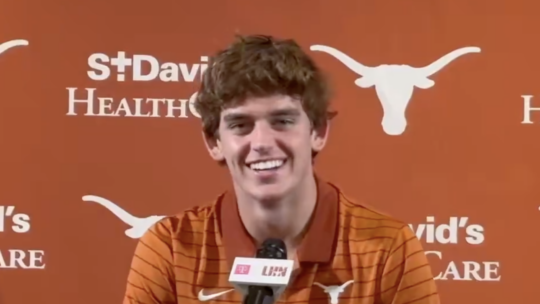
This week's roundup covers what Arch Manning's AI video moment teaches communicators about the medium mattering as much as the message, why the Macklemore-Sheeran-Kraft dispute shows that neutrality is harder to claim once you've already taken an action and new research that finally puts a dollar figure on what a strong reputation is actually worth when a crisis hits.
Arch Manning Laughs at AI Video of Coach Slapping Female ESPN Reporter
What happened: After University of Texas at Austin quarterback Arch Manning laughed at an AI-generated video during a Monday press conference—one that depicted his coach Steve Sarkisian slapping ESPN sideline reporter Holly Rowe—he found himself at the center of an immediate backlash.
The video, which someone created in response to Sarkisian cutting short a postgame interview with Rowe after Texas's dramatic 24-23 comeback win over Ohio State, showed Sarkisian turning back and striking Rowe before yelling at the camera. Manning had called the video "hilarious" and asked reporters if they'd seen it, seemingly unaware of the moment he was creating.
By Tuesday, Manning issued a written apology in an Instagram Story.
"In my press conference yesterday, I made an insensitive comment about an AI video," he wrote. "There is nothing funny about it. It's easy to say I didn't mean it, but I know my words and actions were hurtful to a lot of people. I do not take that lightly and am deeply sorry for that."
He also specifically addressed Rowe.
"I specifically want to apologize to Holly Rowe for what she has personally had to deal with because of my comments. I have a ton of respect for her and appreciate her showing me grace in this moment."
Rowe also responded to Manning via Instagram Stories, giving the public an update on the situation.
"Thank you Arch," Rowe wrote on her Instagram Story. "I appreciate our conversation about this which will remain private. Apology accepted. We move forward with respect and kindness for one another."
Communication takeaways: The episode is instructive for PR pros on several levels. Manning's apology was swift, specific and personal, hitting the three marks that crisis communications advisors most often point to. He didn't qualify or deflect; he owned the comment directly.
Eric Yaverbaum, CEO of Ericho Communications, says decades ago this story would have ended after Manning’s apology, but today’s technologies make that very difficult.
“Because of the mediums we use to communicate today, the 22-year-old Manning’s apology seems incomplete,” Yaverbaum says. “Manning apologized via Instagram Story, which disappears after 24 hours. And yes, while the apology has been screenshotted and shared all over social media, the nature of the medium makes the message come off a bit sheepish.”
Yaverbaum notes that if you look at Manning’s Instagram, he rarely posts anything on his feed besides brand deals.
“Moving his story post to his feed would add a much-needed gravity to his words,” he says.
Yaverbaum inferred that the disappearing apology could be because Manning is young and wants to be done and put this whole episode behind him, but that may not have been the lesson he needed to learn.
“Part of growing up is owning your mistakes,” he says. “Even if that means living with them for more than 24 hours.”
For any public figure's communications team, the lesson is clear: what you laugh at in a press conference is as much a public statement as anything you say deliberately.
The Macklemore, Ed Sheeran and Robert Kraft Dispute Has No Clean Ending—and That's the PR Story
What happened: What started as a concert-based controversy has become one of the more complex public communications flashpoints of the fall.
Rapper Macklemore made pro-Palestinian remarks during his opening performances at Ed Sheeran's MetLife Stadium shows in New Jersey on Sept. 4 and 5. He wore a keffiyeh, showed footage of destruction in Gaza and led the crowd in "Free Palestine" chants.
The backlash from Jewish public figures was swift, including criticism from fellow artist Pink, who wrote that Macklemore had "stood in front of a stadium full of music-loving families, with violent images from a war on the screens" and told "all of the Jews in the stadium that it wasn't about them."
New England Patriots owner Robert Kraft, founder of the Foundation to Combat Antisemitism, confirmed he pressured Sheeran to remove Macklemore from the remaining tour dates, and that he rallied other stadium owners to do the same. Kraft framed his statement around Gillette Stadium's commitment to providing "a welcoming environment for all guests" and not providing "a platform for hate speech."
Concert promoters dropped Macklemore from the eight remaining tour stops. All four of Sheeran's other supporting acts—Finneas, Aaron Rowe, Beoga and Lukas Graham—withdrew from the tour in solidarity. Macklemore's Instagram post announcing his removal was reposted nearly 800,000 times in under a day, drawing support from artists, politicians and public figures including children's content creator Ms. Rachel. Sheeran posted on social media saying he blames the tour's promoter, not himself, for the decision. Kraft also says Sheeran asked him to commit $2 million to Palestinian aid in the wake of the controversy.
Communication takeaways: This story illustrates how quickly a single event can cascade into a multi-party crisis with no clean resolution. Each stakeholder—Macklemore, Sheeran, Kraft, the venues, the promoter, the other artists—has made public statements that shifted the narrative, often in ways that created new problems. Sheeran in particular is navigating a difficult middle position: he has been criticized both for removing Macklemore and for not standing up to Kraft.
Tina Kozak, CEO at Franco, says from a PR perspective, the biggest lesson is the difference between choosing not to take a position and taking an action that has implications of its own.
“Ed Sheeran has every right to avoid weighing in publicly on political issues,” Kozak says. “But once Macklemore was removed, neutrality became much harder to claim. Regardless of who ultimately made the decision, when your name is on the tour, audiences will associate you with what happens under that banner.”
Kozak also says that saying “I don’t do politics” doesn't necessarily insulate you from the reputational consequences of a decision that people perceive as political.
“For years, the conventional PR instinct was to minimize risk: stay neutral, avoid controversy and don’t alienate anyone,” she says. “That approach doesn’t always work anymore. Audiences increasingly expect public figures and organizations to demonstrate what they stand for, and actions often communicate more loudly than statements.”
Kozak found Macklemore’s response to be effective because his words and actions aligned.
“Donating his tour earnings to organizations supporting Palestinians moves the story beyond rhetoric and demonstrates tangible commitment to the position he has publicly taken,” she says.
She also notes that Sheeran's subsequent commitment in humanitarian aid is also significant and adds important context.
“It demonstrates that his preference for a less public, less political posture doesn't necessarily mean indifference to the humanitarian crisis,” Kozak says.
The episode is a reminder that in politically charged situations involving deeply held beliefs on multiple sides, there is often no one communications strategy that satisfies everyone—and the attempt to find one can sometimes make things worse.
New Study Puts a Dollar Figure on Reputation—and the Gap Is $1.2 Billion
What happened: A three-year study of 139 corporate crises at 114 public companies finds that reputation isn't just a soft asset—it has a measurable impact when things go wrong. Companies that entered a crisis in their weakest quarter for reputation value lost a median 20.1% of their value against industry peers at the bottom of the event. Companies with stronger pre-crisis reputation lost 8.5%. On a $10 billion company, that 11.7-point difference is worth roughly $1.2 billion.
The findings come from Augur Intelligence Corp, a reputation-valuation platform built on the insurance industry's actuarial standard for reputation value. The study tracks crisis events across 13 categories—product recalls, data breaches, labor strikes, CEO departures, layoffs, activist campaigns, DEI and sustainability reversals and others—measuring each company against a matched set of industry peers every week from the event through the following year.
Three findings stand out for communicators:
- Reputation acts as a floor, not a trampoline. Higher-reputation companies fall less during a crisis. However, the study finds no evidence they recover faster or finish the year higher.
- Equity damage is drawn out. Losses often continue to accrue even after a company has stood down its crisis response and resumed business as usual.
- Two event types break the pattern. Mergers and activist or proxy concessions—both transacted directly with investors rather than inflicted on the company—show no protective effect.
Communication takeaways: For communicators making the case for reputation investment to a C-suite or board, the study offers something that has historically been hard to produce: a dollar figure. The argument that reputation management is both a financial and a strategic priority just got a concrete data point to back it up.
Aidan Ryan, founder and CEO of Augur Intelligence, and former senior advisor for crisis at high-profile agencies including Edelman and We. Communications, says every reputation you can measure is a reputation you can defend and that this study is the first time communicators can say what the difference is worth.
"Reputation moves enterprise value, and the tools most companies rely on to measure it are slow, costly and questionable," says Ryan. "By the time the numbers arrive, the window to act has closed—and none of them put a dollar figure on what a reputational issue actually costs."
Ryan notes one finding that communicators should pay explicit attention to—the long run of equity damage.
"Equity damage from a reputational event is drawn out over months, not weeks, meaning that losses often continue to accrue even after a company has stood down its situation room and resumed business as usual,” he says. “[It’s because] these decisions are often based on incomplete data."
Nicole Schuman is Managing Editor at PRNEWS.