

PR roundup covers how MapQuest turned a map-naming controversy into its biggest brand moment in 30 years, what the USPS mail-in voting statement reveals about communicating clearly when the facts are still unsettled, and what new research says about why corporate credibility is eroding fastest among the audiences brands can least afford to lose.
Lake Ontario, Lake America and MapQuest's Surprise Comeback
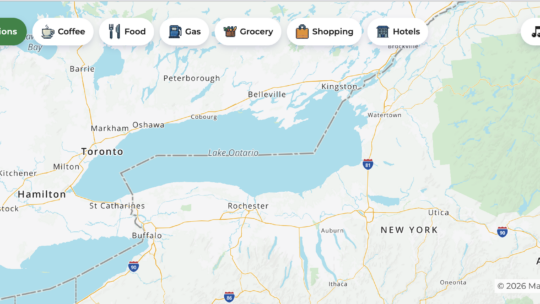
What happened: MapQuest—yes, MapQuest—shot to No. 1 in the U.S. Apple App Store maps category and No. 8 overall on Aug. 30, its highest position in the brand's 30-year history. According to the company, downloads surged to roughly 50 times the app's normal rate after the company made a simple but pointed decision. MapQuest chose to keep Lake Ontario's name on its maps, while Apple Maps and Google Maps updated to reflect President Donald Trump's executive decision to rename the lake to Lake America, following a trade spat with Canada.
It's the second time MapQuest made such a decision. When President Trump renamed the Gulf of Mexico to Gulf of America earlier in his administration, MapQuest not only kept the original name but also built a tool at gulfof.mapquest.com letting users rename it themselves.
The company did the same this week for Lake Ontario, expanding the tool to cover the new controversy. Both times, the brand leaned into the moment without making a political statement. It simply positioned itself as the app that keeps the names people know.
"We took the same approach we did with the Gulf of Mexico: be part of the conversation, and give people an app that keeps the names they're familiar with," says Doug Berger, General Manager of MapQuest. "Hundreds of thousands of people signaled to us this weekend that we got it right, by downloading our app."
Communication takeaways: The MapQuest story is a prime PR example of finding and owning a lane. The brand didn't lecture. It didn't take sides explicitly. It simply did something concrete—kept familiar names, built a playful tool—and let users respond.
According to a recent report from Adtaxi, 42% of consumers say they prefer brands that stay neutral and focus on their products. MapQuest found a way to take a position without taking a political one. The result was a brand revival story that no marketing budget could have manufactured.
Brett Bruen, President of the Global Situation Room and a former U.S. diplomat, referenced the agency’s recent Reputation Indexes, where targeting by President Trump has consistently landed in the top risks for brands.
“The case of Lake Ontario is just the latest reflection of the Administration applying unprecedented pressure on private companies to fall in line with their policies and political preferences,” Bruen says.
Bruen notes that capitulation, such as what is happening with Apple and Google, can come at a cost.
“It may seem like a prudent path to avoid additional retribution,” he says. “But, bearing in mind how unpopular this president has become and the midterms around the corner, it is in many cases a short-term solution that may cost consumers and brand loyalty over the long run.”
USPS Issues Statement Amid Mail-In Voting Confusion
What happened: With midterm mail-in voting set to begin and a federal court order blocking key parts of President Trump's mail voting directives, the U.S. Postal Service is navigating a public information challenge as much as a legal one.
A whistleblower report submitted to Sen. Richard Blumenthal, D-Conn., raised concerns that USPS has been rushing out insufficiently tested technology for a new Federal Ballot Mail Portal—a system designed to allow state election officials to submit absentee voter information under Trump's executive order.
The agency issued a formal statement on September 1 saying it is "carefully reviewing" those concerns.
With the statement, USPS sought to provide clarity for the public in a confusing moment. With court orders, executive directives and whistleblower disclosures all swirling simultaneously, voters and election officials are left trying to understand what the rules actually are. USPS chose to emphasize what it could confirm: that the portal remains voluntary for election officials, that its work has been consistent with court orders and that ballot verification requirements remain blocked. The agency also leaned on its institutional credibility, noting that "postal employees take great pride in their responsibility to support the democratic process."
Communication takeaways: The story is a useful reminder that in moments of confusion—especially around topics as high-stakes as voting—the public information job is as important as the legal or political one.
When the situation is complex and fast-moving, communicators best serve audiences by being specific about what is known, clear about what is blocked or pending and honest about what remains unresolved. Acknowledging uncertainty directly is almost always more trust-building than projecting false clarity—or staying silent while others fill the vacuum.
John Guilfoil, Principal of John Guilfoil Public Relations, sees the USPS situation as a window into a broader shift in how communications strategy operates in a weakened media environment—and he's not mincing words.
"There's 'bad ineffective' comms and then there's 'bad effective' comms," Guilfoil says. "The Trump administration does the latter. Every word uttered by a member of the communications staff is part of a very carefully choreographed strategy."
In his view, the USPS "carefully reviewing" statement is a feature, not a bug—a response calibrated to be just enough to feed a news cycle without committing to anything, in a media landscape too understaffed to push back effectively.
Guilfoil says it would be a mistake to chalk this up to blunders. And he argues the broader pattern extends well beyond this administration.
"It should not surprise us one bit that, with a severely weakened news media, both crisis comms and general communications strategy models have shifted toward vague strategic nonresponsiveness," he says.
His prescription is pointed: the American PR industry needs to adopt the ethical standards of the Public Relations and Communications Association (PRCA), the global governing body of PR, including publicly calling out those who violate professional norms.
"If we have a problem with the way the Trump administration—or anyone else—is conducting media relations and public relations, then it's up to us in public relations to call it out," he says. "No one is coming to save us, least of all the newspapers."
New Research: Corporate Credibility Is in Crisis—and Companies Are Making It Worse
What happened: A new national survey from crisis communications firm Resonant Advisory Group, conducted with DHM Research, finds that corporate credibility is thin, uneven and declining—and that the gap between what companies say and what audiences believe is widening at exactly the wrong moment.
This is an interesting study in light of the USPS story above. Only 5% of Americans find corporate statements "completely credible," 63% say crisis communications have gotten less credible in just the past year, and a third start from outright skepticism before a company has said anything at all.
Four findings stand out for communicators:
- The AI Trust Tax: AI in business operations is the single least credible topic companies communicate about—48% call it "not credible"—at the exact moment most companies are leaning hardest into AI-forward messaging. Naming AI as the reason behind a hard decision may be accurate, but to the public it reads as evasive rather than a genuine account of what happened.
- The CEO Dichotomy: In 6 of 7 head-to-head comparisons, audiences reward steady, humble, operationally focused leaders over bold, visionary ones. The one exception: a visible, socially present CEO beats a low-visibility one. Presence still matters, and audiences want to see a leader show up. They're just drawing a clear line between showing up and putting on a show.
- The Affluence Paradox: Credibility erosion is worst among higher-income, more news-engaged audiences—70% of those earning $150K-plus say crisis communications have become less credible, compared to 54% of those earning under $50K. Business isn't losing its most casual audience. It's losing valuable customers and informed critics.
- Credibility Source: Company employees (29%) now narrowly edge out the CEO (27%) as the most credible crisis messenger. Proximity to what actually happened earns belief—not seniority.
"Companies and communicators have stretched credibility to its potential limits," says Erik Moser, President of Resonant Advisory Group. "The solution is a focus on the fundamentals: the daily interactions, simplifying language and protecting credibility."
Communication takeaways: The report's most useful insight is this: the 5% headline isn't a crisis communications problem—it's a daily operations problem. Credibility isn't built in a single announcement or lost in a single misstep. It's built or spent constantly, in ordinary moments that happen long before any crisis begins. Treating it as a daily discipline rather than a response plan is the clearest opportunity the data surfaces.
"When a company posts record profits and lays off thousands of people, the disparity is obvious to the public and to its own employees, and it costs the company credibility when it isn't accountable for the decision,” Moser says. “This creates the risk of, 'what if we're not believed?' when a critical moment occurs.”
As for those daily, fundamental disciplines? Moser says it comes down to respecting the relationship with your audience.
“Communicators need to ensure statements address the actual issues that matter, that they're understandable to a reasonable person, and that they share real information with the audience so they can make informed decisions for themselves,” he says.
He notes something just as important: communicators sometimes lack the bandwidth or resources to do all of these things—another reason to examine why a brand is losing credibility.
Nicole Schuman is Managing Editor at PRNEWS.