

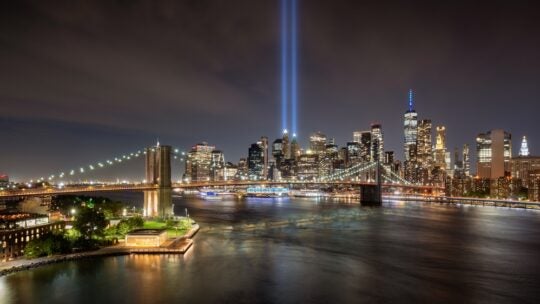
Twenty-five years ago, on Sept. 11, 2001, the world changed in an instant. For communicators, that moment carried a particular weight. They are, by profession, the people tasked with finding words when words feel impossible.
PRNEWS asked the PR community to share their personal stories of Sept. 11—if they felt comfortable doing so—and how that day shaped their lives. What follows are their stories, in their own words—from the PR pro who spent weeks doing media interviews for the Red Cross, to the intern watching the towers fall on a hotel lobby TV, to the former police officer driving toward the Pentagon as everyone else fled.
Some were just starting out. Some were seasoned professionals. Some were in New York City. Some were in Paris. Some were in Washington, D.C., or Boston. All of them carry that day with them still.
Thank you to those who openly shared and entrusted PRNEWS with their stories.
Crisis Comms in Action
For many, Sept. 11, 2001 started out as any other normal work day. But plenty of people in the PR and communications industry experienced long hours getting out important information to colleagues and stakeholders for the days and weeks after.
Neal Gorman | Public Relations, American Red Cross
I was about 29, working full time in media relations and communications for the American Red Cross in Rochester, N.Y.. My pager and cell began to ring nonstop with calls from family, reporters, friends and my worried mother. I did nonstop interviews with media outside the Red Cross for hours and days and weeks. They trusted me, and I somehow knew how to speak without causing more panic. I deployed to D.C., where I saw the Pentagon devastation and worked at the national call center we set up, then to the Brooklyn Red Cross headquarters, where I was onboarded, then to a family resource center on Canal Street. It was an overwhelming, nonstop fire hose of raw input and experiences: the wall of teddy bears at the Pier 94 Family Assistance Center, the items and missing persons notes left all over Manhattan, the grieving families we worked with, the incredible resilience, the amazing New Yorkers who lined the West Side Highway to support workers, the smell of the burning pile, rinsing your shoes when you left. 9/11 shaped who I am. I stayed nearly 20 years in New York, met my wife, we raised our kids in Brooklyn, and I teach them compassion—and that no matter how dark things get to stay strong and kind, and everything will be OK.
Susana Leyva | Bilingual Communications and Public Affairs Professional, United Airlines
I worked at United Airlines on 9/11—and I was stationed in the Crisis Center. I can close my eyes at any time and remember the clear blue Tuesday sky, my pager going off, walking to the Crisis Center and hearing buzz about a small airplane hitting one of the towers. From the moment I sat down to do my job, I saw things unfold that I couldn't wrap my brain around. I remember watching United 93 turn around on radar. I remember thuds and asking what that sound could be—it was people jumping from the towers. I remember all those planes landing on runways that had never seen a 747. I remember the FBI stationed in the Crisis Center and getting the passenger lists with the names of the hijackers. And I remember stopping at some point to tell myself to breathe—scanning the Crisis Center where every single woman and man at that company gave everything they had to meet the moment of an unprecedented act of war, focusing on those passengers and their families. That's all that mattered. No one slept. Someone finally remembered to bring in water many hours later. Hours and days felt like seconds. And somehow, it all still feels like it was yesterday.
Debra Silimeo | Communications Consultant, Hager Sharp
9/11 was my first day back in the office after cancer surgery. I was finally feeling well enough to get dressed and go in. The Hager Sharp office was just two and a half blocks from the White House. I had a large TV in my office, and everyone came in to watch what was happening. Then word came that Washington, D.C.—possibly the White House—was the next target. People started to leave. I looked down and saw the streets were gridlocked. There was no getting out.
The thought did cross my mind that I would survive three rounds of cancer but possibly die when they hit more Washington targets.
After the devastation, it seemed that all Americans revered firefighters and respected their bravery like never before. I proposed to my client, the U.S. Fire Administration, that we seize this teachable moment to urge people to take steps to prevent a leading cause of firefighter death: having to go into burning homes and buildings. By having a working smoke alarm, you can get out—and they don't have to come in to rescue you. A young account executive came up with the winning creative: the voice of a child saying, "My dad is a hero. He runs into places other people are trying to get out of. The best thing is when he comes home at night—and here is how you can help." Simple, but powerful.
We launched the campaign, Tribute to Heroes, at the National Press Club. The TV PSA alone generated airplay worth over $10 million. Firefighters all over the country loved it. If even one life was saved by people moved to install or check their smoke alarms, I hope we were able to do something meaningful in the wake of this unspeakable tragedy.
Todd Sedmak | Strategic Communications Executive
On 9/11, I led media relations for American University. Soon after the attacks, local, national and global media called seeking experts. AU had recently hired Akbar Ahmed as chair of Islamic Studies—the former Pakistani ambassador to Great Britain. He did everything from "Oprah" three times to CNN, educating people about Osama bin Laden's terrorist actions and helping others understand that U.S. foreign policy touches nine countries, five of which are Muslim, and that America should do more to build bridges as it crafts its foreign policies.
Melanie McGovern | Public Relations, Media Relations, Marketing
I was a radio news reporter in Buffalo—an "AM newser," covering a very boring Buffalo mayoral primary race for the morning news. I was driving around to polling places when I heard that a "small plane hit the World Trade Center" on our air. I got out of the car to get some interviews with voters. When I got back, my pager and cell phone were both going off: "Get to the airport—a plane hit the World Trade Center!" By the time I got there, everyone was in shock or crying. We did our interviews and headed back downtown to City Hall. At this point, I had not seen any footage yet. When I walked into the mayor's office, I saw it—and it stopped me in my tracks. I ended up getting an engineer to help with live broadcasts (unheard of in radio in 2001) for the rest of the day, in time to see Erie County send emergency vehicles and personnel to New York City. Once I finally got home after about 18 hours, I sat on the couch and turned on the TV. Every station was showing the coverage except one. Comedy Central was showing the movie "PCU," so I just sat and stared at it to clear my brain. Slept for an hour and went back to work. I remember every minute of that day.
Filomena Fanelli | PR agency CEO
I was a young, rising executive at Rubenstein Associates in New York City when 9/11 rocked all of our worlds. At the time, I was in the agency's real estate group, working under the incredible Steve Solomon, and one of our clients was Larry Silverstein, the real estate magnate who held the lease for the World Trade Center and owned 7 World Trade Center outright. After experiencing some of the moments many others had—hearing a yell down the hallway, gathering around the TV and shrieking as we watched the first tower get hit, then the second—the most real moment in PR sunk in. It wasn't long after evacuating and flying down 23 flights of stairs and smelling the smoke that I was right back at my desk, filling in for others on the team and answering the phones. It taught me a powerful, poignant lesson: What we do in PR matters, but it matters even more when it's hard. Sharing information clearly and calmly, responding to the media and ensuring the public had the facts straight provided a sense of comfort in the midst of heartbreak. When a crisis hits, your title doesn't matter. Humans do.
Laura Gross | President, Scott Circle Communications
I was working in the PR/communications department of NPR in D.C. My job was to promote news programs. On Sept. 12 or 13, my boss asked me to promote NPR's programming to the media, and I told her I thought it was too advantageous, and we shouldn't be promoting something so soon after. She was very smart and appealed to my sense of advocacy, saying something like: "Our coverage is informing people what is going on, and that's a public service." Of course, I did as she asked— nd she was right. NPR became a tremendous resource for covering 9/11, the aftermath, the war in Afghanistan and anniversaries every year.
Paula Bosler | Communications Advisor
The sky was eerily silent that morning as I drove to the FedEx Hub at Indianapolis International Airport. The FAA ground stop halted all flights nationwide. FedEx quickly expanded its logistics network and trucking fleet to deliver essential disaster-relief items to Ground Zero. It was an honor to work with the extraordinary operations teams who did everything possible to deliver vital emergency medical supplies over the next several weeks.
John Gonda | VP, PR & Media Relations
I was working in my first after-college PR job at a local health system in northeast Ohio. We all found out about the tragedy from patients watching the TVs in our waiting room lobbies. We had an intern at the time who had family in New York City, and the panic and stress on his face was terrible. Our health system was only about an hour from Cleveland, and Flight 93 had been hijacked in their airspace, leading to additional panic from those who had friends and family in the Cleveland area as well.
Internal Comms & Employee Communications
For many communicators, keeping employees informed and safe tops the list as their number one priority. On Sept. 11, employees across the country looked to their employers on what to do next—so clear, concise information was key.
Joseph Caldwell | Communications & Strategy Executive
I was the managing editor of the employee newsletter for a national insurer with its headquarters in the Flatiron District of Manhattan on 9/11. We sat and watched the horror unfold on a large projector screen in a conference room with the heads of PR and marketing. As the towers fell and gasps were followed by silence and tears, we quickly decided to communicate primarily through our emergency network protocols and leverage our recently launched intranet. As one of the few coders, I elected to stay in the office as messages were carefully crafted, all considerations made, and senior leaders reviewed and approved. I worked with the SVP of Corporate Communications and Secretary of the Board to release and publish the messages into the early evening. I then walked up an abandoned Park Avenue—still silent with shock and covered in sadness. It wasn't until I got to Grand Central Station that night to take what I believe was the last train out that the magnitude of the situation set in. I saw a completely empty station—just the remaining police and myself. I sat on the stairs facing the famous Grand Central clock, wiped the welled-up tears from my eyes and waited in the thick silence of an unspeakable tragedy.
Heather Caldwell | Corporate Vice President, New York Life Insurance Company
On 9/11 I was serving as communications supervisor in our regional State Farm Public Affairs department in upstate New York. I remember being in a meeting discussing the launch of our new auto insurance fraud campaign when our corporate counsel, joining via teleconference, told us to turn on the TV. Those of us in the conference room watched in horror as the second plane hit. The head of our media relations team happened to be visiting our regional office that week—seeing him leap into action while remaining composed under pressure is something I'll never forget. It reminds me that we should, above all else, be there for our customers, especially when they need us most.
Nicole Hawkins | Nicole Hawkins Communications + Advisory
I was the PR director at Capital One Arena in D.C. It was my first day back to work after attending my brother and sister-in-law's wedding. The arena is situated between the Capitol and the White House, so staff was instructed to stay in the office for a while. It shaped how I approach two things: crisis comms—being prepared for the worst while hoping it never happens—and employee comms—communicating clearly with employees during times of uncertainty.
Meghan Holston | Chief of Staff, Small Girls PR
I was a comms major at NYU but living just a few blocks away from the World Trade Center in the Financial District on 9/11. I ran that morning as the first building fell and the dust cloud enveloped us. We were desperate for news and direction—where to go that was safe, what was actually happening, who we could trust to give us accurate information. In the days and weeks that followed, I remember being so frustrated by the internal comms directed at those who were displaced. We were supposed to return to class but with no books, no computer, no belongings and no counseling to reassure us we were safe. I went on to a career in PR, and my commitment to clear and thoughtful internal comms is on display every day in my role as chief of staff. I live by the motto: Put yourself in the audience's shoes.
Career-Defining Moments
The events of Sept. 11 shaped many communicators' careers, leaving a lasting impact on what they wanted to bring to the profession.
Blair Huddy | Founder, Hudson Davis
I was still a kid—13—but it made me want to pursue journalism. Seeing the news coverage and wanting to be part of telling those important stories is what pulled me into the profession.
Jordan Valdés | Founder, Varnum Street Strategies
In my freshman year dorm, two hours later I was donating blood, and two weeks later I changed my major to poli sci (minor in Middle East conflict), two years later became a reporter in the Gulf and two years after that a master's student at SAIS.
Sheri Singer | Founder, AXC
I have such mixed feelings about that day. I was on Route 110 when the plane hit the Pentagon. I had to jam on my brakes as a first responder drove over the grass to get there. But I had to go into my office since I had an aeronautical trade press roundtable scheduled that I had to cancel. Working for a D.C. PR agency, one colleague was dating someone in the White House advance team. She ran down the hall yelling we all had to leave the building—two blocks from the White House— because a plane was headed to D.C. That was the plane that went down in Shanksville. I stood by the elevator and thought, "I do not want to die with these people. I need to start my own firm now." A month later I had my first Singer Communications client, and I've never looked back.
Eman Quotah | Award-winning communications advisor and novelist
On 9/11, I was a young, new administrator at the Center for Contemporary Arab Studies, a Georgetown University academic center focused on the Arab world. I am half-Saudi and spent part of my childhood in Jeddah. I remember getting an email from my mom telling me to look at the news. CCAS had a lounge with a television. Students and staff came to the lounge and sat watching, mostly silent and horrified, but some also expressing deep fears about what would happen next: "Please, let the perpetrators not be Arabs…" We could not have fully predicted the War on Terror and the surveillance and bigotry that would affect Arabs and Muslims in the years to come, but we knew enough to sit with both grief and horror for the many deaths we were watching and fear for the future of Arab and Muslim communities at home and abroad. As a communicator, living through 9/11 strengthened my commitment to telling the stories of American Muslims and Arab Americans.
Sara Joseph Noyes | EVP, Head of Travel & Lifestyle, Orchestra
Sept. 11 profoundly shaped both my life and my career. I was working in Weber Shandwick's Travel & Lifestyle practice and still remember that beautiful, sunny New York morning. By the time I reached our office, the first plane had struck the World Trade Center. Our team gathered to watch the news, and when the second plane hit, we understood our country was under attack. As travel came to a standstill in the months that followed, I thought deeply about the industry's role in the world. Travel brings people together. It allows us to encounter different cultures, learn from one another and replace fear of the unfamiliar with understanding. Whether we travel for business or pleasure, being with people from other places makes us more curious, more connected and ultimately more united—the very opposite of the division and fear that terrorism seeks to create.
Being There
Some of the PR community experienced the tragedy on-site, losing colleagues, family and friends. The memories of 9/11 live on for many of them, who use that experience and perspective to make an impact on the world.
Kristen Sharkey | Global Corporate Communications Professional
I'm always a bit hesitant to share my September 11 experience because so many people experienced terrible loss. I was fortunate—in midtown, scared but safe and surrounded by amazing people. I remember the blue, blue sky as I walked down 42nd Street to my job as an SAE at Porter Novelli New York. I stopped at Au Bon Pain for an orange scone, usually a Friday treat. It just felt like an orange scone kind of day. I had just sat down when my mom called my work phone, panicking. I pulled up the news and ran to the conference room just as the second plane hit. I remember my PNNY friends—the women I was with that day who became friends for life. We walked 30 blocks uptown together, often looking back at the terrifying smoke to the south. Third Avenue was empty, so we walked in the middle of it. People were crying. We stopped beside cars to hear news reports on their radios. Every Sept. 11, we reach out and thank each other for being there that day. On one of humanity's worst days, I remember the people around me who literally held each other up. We still do.
Laura L'Esperance | Executive Vice President, Public Relations, VVK PR + Creative
I was five days into a new role at Merrill Lynch in the World Financial Center when we heard the first plane crash into the North Tower and saw the billowing smoke from our offices, made the decision to evacuate the 11th floor, then watched United 175 crash directly into the South Tower. Communicating with our families, colleagues and friends was impossible—my flip phone could receive messages, but I couldn't call out. Those of us at the site knew less than those watching on TV, and snippets of messages were a mix of truth (the Pentagon) and rumors (the Golden Gate Bridge) about destruction elsewhere. Our small group found ourselves physically trapped by the Hudson River and were forced to wait out the collapse of the buildings until, covered in debris, we could make our way to a boat lift and eventually walked up the west side of Manhattan. What I witnessed on 9/11 inspired me to take my communications acumen to a veteran-serving nonprofit, focused on post-9/11 veterans, where I led communications and external relations for nearly a decade.
Crystal Newcombe Nosal | Public Affairs, Metropolitan Washington Airports Authority
In 2001 I was a newly solo police officer in Arlington County, home of the Pentagon. Work-issued cell phones and even pagers were not prevalent at the time, so it was up to us to self-report to the county as soon as we heard a plane struck the Pentagon. It was surreal to drive on empty highways toward D.C. while the majority of people were flooding away from the city. I had no comprehension of just how life-defining an event I was living through, probably because I was young and did not have a lot of life experience. I simply focused on doing my job for as long as I could. Each anniversary brings its memories and challenges, especially as we get older and have to say goodbye to colleagues from illness attributed to 9/11 response. Something on this scale definitely puts any other "crisis" in perspective.
Netta Conyers-Haynes | Global Communications Leader
On 9/11, I stayed glued to the news. By evening, a familiar face appeared on the screen—Mark Bingham, my former PR boss. My first reaction was pure PR instinct: How did Mark manage to break through wall-to-wall coverage on a day like this? I wasn't listening to the newscaster. I was fixated on his photo, waiting for him to speak. Then it slowly began to hit me. He's not speaking. Something was wrong with this picture. Mark was on Flight 93. I met Mark early in my PR career at an agency where I reported to him. He was the person I called when I was debating grad school, when I wanted to talk trends, when I needed a sharp, honest read on the industry. He later founded the Bingham Group—a reflection of his talent, intellect and integrity. Mark was one of the good ones. Smart, strategic and generous with his insights. I learned PR from Mark. I often wonder what he would think about the world we communicate in now. He would have had a point of view that made us all think harder. We lost one of the brightest PR minds on 9/11. And I've never stopped remembering the way his work and humanity shaped mine.
Jeremy Friedman | VP, Public Relations, Outlyr
I was a young PR account executive for sports marketing agency Kaleidoscope Sports and Entertainment, on 32nd and Fifth. I lived in Brooklyn and took the subway to the city. We all huddled in our main conference room watching the morning unfold, trying to reach colleagues and friends. Our entire building was ultimately evacuated due to our proximity to the Empire State Building. Three of us lived in Brooklyn. We made the six-plus hour walk along with our fellow New Yorkers—all supporting each other. The three of us connect every year on 9/11, always thankful we had each other.
At the time, I was also the PR director for the Oldsmobile Scramble amateur golf tournament, with the national championships taking place in October at Disney. One of the teams that had qualified from Port Jefferson Country Club on Long Island featured FDNY Firefighter Frank Bonomo, one of the heroes from Brooklyn's Fire Engine Co. 230, who passed away that day. Ultimately, the team competed in Frank's honor at the national championships. As the event's publicist, I navigated telling this story to a national media audience—which was deeply personal to me. I have the clips and segments to this day. This experience has shaped my career.
Lisa Fels Davitt | Founder and CEO, Succession Communications
I was working at Porter Novelli in midtown Manhattan. When the second tower fell, we knew instinctively that midtown —two blocks from Grand Central Station—was no place to be. With four friends in tow who lived outside New York City and were stranded in Manhattan, we walked up Third Avenue to my apartment on the Upper East Side. People were crumbling around us. A colleague stopped to comfort a few people on the side of the road. It was sheer chaos and terrifying. We hesitated to look behind us at the white cloud of smoke. Not knowing what was coming next, we stopped at a few stores to grab cash, food, blankets and flashlights. That shared experience bonded the five of us for life, and we've contacted each other every year since.
Hilary Reiter Azzaretti | Founder, Redhead Marketing & PR
I am a New Yorker who was still living in Manhattan on Sept. 11. I used my parents' Jeep to haul supplies to staging areas by Ground Zero. I'll never forget the look of exhaustion and despair on rescue workers' faces, or the penetrating smell of burning metal. Filled with fear, I decided to leave the city for three months by accepting a contract PR role with the Sundance Film Festival—fully intending to return to New York City. Well, 25 years later, I am still in Park City, Utah, where I launched Redhead Marketing & PR and met my husband. I also have the privilege of managing PR for the 9/11 Day meal pack in Salt Lake City, one of 51 participating cities this year that will pack 17 million meals for Americans facing food insecurity. Sept. 11 changed the trajectory of my life in a multitude of profound ways.
Monique Kelley Gigliotti | Best-selling author, keynote speaker, fractional biopharma communications head
My dad was supposed to join his HP colleagues at the top of the North Tower at Windows on the World restaurant—only he was running late that day. My dad never runs late. I was a comms student at Boston University's College of Communication at the time and didn't know if my father was alive for what felt like two hours. Thankfully, he was OK. His coworkers weren't as fortunate. Every year, we watch the 9/11 Memorial service on TV as a way to honor and remember them. My life and career have been shaped by that day—as the daughter of a father I almost lost, and as a Middle Eastern-American woman who is acutely aware of her freedoms and privileges here. As a comms exec, I advise brands and C-suite to be sensitive and empathetic when communicating sensitive milestones and news.
Lessons That Stuck
The impact of Sept. 11 provided lifelong lessons and guidelines for how communicators approach their positions and lives.
Loretta Prencipe | Energy & legal PR pro
I was a reporter at InfoWorld. Here's what I remember to this day: We had reporters at conferences across the country. The day after, Michael Vizard, who was news editor, gathered us for a virtual meeting. The first thing he said was, "Everyone is accounted for"—meaning our editorial teammates. Next he listed who on our advisory board was lost in the towers. Then we discussed assignments and got to work. I respect the people-first approach he took. What a dreadful moment in time.
Gregg Feistman, M.A. | Professor of Practice, Public Relations, Temple University
9/11 was the day the CEO picked to publicly announce our first year's earnings. We were a year ahead of plan and I had five major news outlets—including The New York Times and The Wall Street Journal—scheduled for one-on-ones with him. I remember watching CNN's coverage in the conference room with other stunned, upset colleagues when someone from the back of the room said, "Hey Gregg, your release just cleared the wires!" At that point it didn't really matter, and we went into a news blackout for at least the first three weeks afterward. There are some things bigger and more important than company announcements, no matter how positive they may be.
Kimberly Myers | Public Relations Specialist
On 9/11 I worked for a small PR/IR agency on the 20th floor of the MetLife Building attached to Grand Central Station. Our president shut down the office immediately given our proximity to a major hub. I lived in Brooklyn and the subways weren't running, so I stood on Fifth Avenue and watched the buildings fall and waited. In the days to follow, I thought about the need for every organization to have a solid disaster preparedness plan—one that includes not only a list of to-dos but also corporate positioning statements in response to events. A positioning statement that addresses internal and external audiences and is in line with corporate objectives and community standards. In my list of clients were several of the country's largest radio broadcasting companies—organizations whose purpose was to use public airwaves to entertain and inform Americans at the local level. 9/11 amplified the importance of public-facing organizations having a communications strategy when national disasters happen.
Jeff Cronin | Communications Manager
I was a reporter at the Carlisle Sentinel, a small community daily about two hours from Shanksville, Pennsylvania. When we all understood the gravity of what was happening, one of our editors pulled us into the conference room to underscore the importance of our work that day: "We are the storytellers documenting history as it's happening. Don't take it lightly." Even on the PR side of the fence, I've never forgotten that moment and what a privilege it is to be a storyteller.
Jenny Beres | Co-Founder, Pink Shark PR
I was 18, driving home from an early morning college class. I had the R&B station on and the local DJ started freaking out that a plane had just hit the first tower, telling everyone it was Armageddon. I had grown up in a high-control religion that very much believed in Armageddon but had long since left— et hearing this man's certainty amid all the uncertainty of the moment had me second-guessing myself. I ran into my house and woke up my parents, promptly announcing that Armageddon was here. After a moment to calm down, it struck me: I had the same facts as everyone else, but how the story was told to me—given my unique background—changed my entire perception, perhaps even my beliefs, for a moment. I understood then that telling the right story to the right audience depends very little on facts and everything on knowing your audience. That day I learned something about media and journalism that has helped me navigate the industry ever since.
Suzie Linville | Director of Communications
Sept. 11, 2001, changed the way I viewed storytelling and the responsibility that comes with communications. I was a year out of college, in my first PR internship, working at a hotel in Boulder, Colorado. My family was still on Long Island, and I had friends working in New York City's financial district. That morning, hotel guests watched the first tower burn, thinking a plane had gotten off track. When we watched the second plane hit, I knew it was an attack. I spent the morning calling friends downtown, some of whom had to run when the towers collapsed. I was still an intern, pitching phone books, but that day made storytelling feel much more consequential. I saw how people respond to information during a crisis, how communication can provide clarity and reassurance and how stories can help people process what they are experiencing. Communications is not just about getting a message out. It is about understanding people, meeting them where they are and telling stories that matter.
Jared Meade, MPS, APR | Founder & Principal, Rayne Strategy Group
In 2001, I had not yet started my professional career. I was still in college, walking through the student center at Eastern Michigan University on my way to a journalism class when I saw the smoke billowing from the North Tower on a television. It was still early, and no one yet knew it had been a terrorist attack. Partway through my class, we received word of what had happened. I remember feeling confused, anxious and worried because no one knew why this was happening. All we knew was that something profound had shifted in the world. That experience caused me to look deeper at the cause and effect of events and to recognize how vastly different perspectives can be depending on the context of our lives. It also taught me that as communicators, we need a firm understanding of human behavior and psychology if we are going to communicate effectively in a world that can change in an instant.
Kayla Siefker | Corporate Communications Analyst, Compuware
On 9/11, I was a PR newbie in the second year of my career, working my first PR job at a tech company in the Detroit metro area, handling PR and analyst relations. That morning, I was in a store near our corporate comms suite chatting with the owner and watching "Good Morning America." We saw the first plane hit the North Tower and initially thought it was a horrible accident. Then we watched the second plane hit the South Tower live, and it became clear something much bigger was happening. I ran back to tell my comms team. No one knew what I was talking about, and at first they didn't believe me. I turned on the TV, and we watched the news coverage together. Soon after, our VP received devastating news: Two of our colleagues were passengers on the planes that hit the towers. One was a PR manager and the other a product director. It was the first time I witnessed crisis communications unfold in real time, led by some of the best communicators I've ever worked with. I learned a great deal that day about communicating during an unimaginable crisis. But more than anything, I remember the shock, fear and profound sadness of realizing the tragedy had also hit our company personally.
Unforgettable Accounts
Lawrence J. Parnell | Principal, Parnell Communications
I was leading global PR for Ernst & Young and was on an extended trip meeting with colleagues based in Europe. That Tuesday morning I was in Paris, returning to London, when I got the call from home. We watched the news unfold on TV in the departure lounge for the train back to London via the Chunnel. Once we were underway there was no news access for 1.5 hours during the crossing. Two things struck me: being out of touch during a major crisis, and the different way America was perceived. In France there was an edge to the expressions of sympathy, while in the U.K. people were genuinely keen to join and support however the U.S. responded.
Greg Snapper | Founder, Summit Trust Partners
I was assistant editor at our college newspaper, The Butler Collegian, and we watched the planes hit in our dorm rooms. We rolled out and headed to the newsroom. Repeated the whole thing again when the space shuttle Columbia disaster happened. We were ready. What a rough time to grow up in the world and figure out the future—but it prepped us for good things ahead.
Gregg Schoenberg | Executive Coach and CEO Advisor
I was working a few blocks from the towers and watched both planes strike their targets from my boss's office at SG Cowen. It was a terrible reminder that we do not control our destiny. Sometimes we think we do, but then—tragedy. In the subsequent 25 years, I have lived a better life because of this lesson. I am more grateful for each day in which the universe—not me—decides to give me another bite at the apple.
Dustin Siggins | Communications Consultant
I was in geometry class when we found out, and it is half the reason I went into the Army Reserve and then the Army National Guard right out of high school in 2004. It was also a big part of why, when I started working for Congress in 2010, I was pretty cynical about the political system. I watched all the mistakes related to the military actions—from far away and up close—and the self-centeredness of politicians. I was lucky to never deploy. But between my political background and some of our client work, it's striking how little we have learned since then in terms of how we act politically and militarily overseas, and how we treat veterans upon their return.
Dawn Fallon | Founder and CEO, New Dawn Communications
9/11 will be forever marked in my memory. I was a senior account executive working in Newark, New Jersey, at Winning Strategies Public Relations. We were all gathered in a conference room for our regular staff meeting. As the meeting was taking place, from our large window we saw one building go down, and then another shortly afterward. My boss ended the meeting and we all went home. I called my former bosses who represented Windows on the World to make sure they were safe. Thankfully, they were. From that day on I've been more intentional about my relationships with former colleagues, who are some of my dearest friends. A workplace—remote or in person—can be like a family.
Laura Often | Brand Storyteller
I was early in my PR career, working in Needham, Massachusetts, and we had two major product press releases going out that morning at 8:30 a.m. So I was busy getting those releases out, working with PR Newswire and completing all the post-release checklists. When the first plane hit, we were all confused. By the time the second hit, we were gathered in a conference room watching the news unfold. We had a team of people in Europe who couldn't get back home for weeks. I just remember the quiet. We were near a major highway and suddenly everything just stopped. Later they asked us to reissue the news—but we didn't. We did change the dates on the releases, though.
Susan Sweenie | Marketing, PR & Communications
I was a few years into my first PR job and was at my desk when our receptionist alerted us and we all gathered together to watch the news. It rocked us—I felt stunned and glued to the coverage. I was impressed not only by those jumping in to help during such a tragedy, but also by those covering the events as they unfolded. Sept. 11 showed me what great communication is and why news matters. There was no playbook for moments like that.
Caroline James | Public Relations, Media Relations, Communications
It was close to 11 p.m. on a Tuesday night in Melbourne, Australia, when the 9/11 attacks occurred. I was already asleep. The next day, coming into my PR job at Porter Novelli, my colleagues and I spent the morning reading and watching the news coverage. Everybody was in shock. I had been working with our client and academics to create a national Wellbeing Index that launched in 2000. As a result of the attacks, we included "traumatic events" in our next survey round, where we were able to compare findings from the year before. It turns out external traumatic events that are societal rather than personal do have an impact on one's overall wellbeing—for about three months. By the next survey, results had returned to baseline. Our research findings were significant and widely reported, and the campaign won recognition from the Public Relations Institute of Australia.
Chris Goddard | CEO/Founder, CGPR
I was driving from Marblehead, Massachusetts to New York City for a new client meeting on Sept. 11, listening to "Imus in the Morning" when I heard what was happening. I pulled over and stopped at our Rowayton, Connecticut, office to try to gather myself and make sense of what I was hearing. My husband had just flown out of Logan Airport on his way to Nice, France. I tried to reach him but couldn't get through. I turned around and drove back to Boston. Driving past Logan was incredibly eerie. There were no planes in the sky. Everything was so quiet. It taught me to simply stop and take a minute when something happens that is bigger than you expected or prepared for. Twenty-five years later, I still think about that day—especially the quiet blue skies over Boston for the week that followed.