

Fear. Guilt. Pressure. These are emotions most climate communicators are familiar with. Many have believed them to be the key to get individuals and organizations to pay attention, to act and to care.
Yet despite the emphasis on these emotive messages in recent years, it seems that things are not going as planned. Earlier this month, the United Nations warned the world failed at limiting global warming to 1.5 degrees Celsius—it missed the goal entirely. Year after year, the U.N.'s Conference of the Parties (COP) comes and goes with very little in the way of substantive agreements or progress on decarbonization. Summers get hotter. Storms become stronger.
And at a time when the outlook has never felt worse, climate practitioners are met with more pushback, more scrutiny and far less collective progress and visibility. The Environmental Protection Agency has stripped itself of its own authority, corporate greenhushing is on the rise and the news cycle is fractured with a range of crises. The numbers bear this: GlobeScan research found the share of consumers seeing sustainability messaging dropped from 49% in 2023 to 36% in 2025, while research from Potential Energy Coalition showed global climate change news coverage falling 38% from a peak in 2021.
So, what are climate communications professionals to do? The answer is clear: not the same thing as yesterday.
Emotions Drive Climate Engagement
The Purpose Center of Excellence at Allison Worldwide sought to unlock the holy grail of climate communications: determining which emotions drive engagement behind key topics in the climate landscape. To do this, the team used a distinct set of data to analyze 20 climate-related topics over an 85-day period, examining nearly 75,000 pieces of content. Topics ranged from economic losses and supply-chain disruptions to ocean warming and acidification. It then layered in 18 emotional drivers across the analysis to identify what actually moves people.
Based on the analysis, they came to three key conclusions:
- Dread isn’t an impactful motivator.
- Nonstop major weather news reporting is leading to desensitization toward some climate topics.
- Fairness has high emotional intensity related to the topic and can be used to create communications that resonate.
Why Dread No Longer Works
Let’s unpack dread. For years, many professionals thought they could simply scare people (and organizations) into submission. Paint a dreary picture of the future and soon everyone will care. But the research found dread not breaking through as a motivator. Of all 18 emotional drivers, dread falls straight in the middle of the pack—ranking ninth overall. In fact, only five of the 20 climate change topics carry dread as a top five emotional driver. Much more likely to inspire caring are emotions like trustworthiness (how much the public trusts the institutions or sources), victim identity (whether specific identifiable victims are involved), human origin (whether the risk is human-caused/man-made) and moral concern (the degree to which coverage frames the issue as moral or ethical).
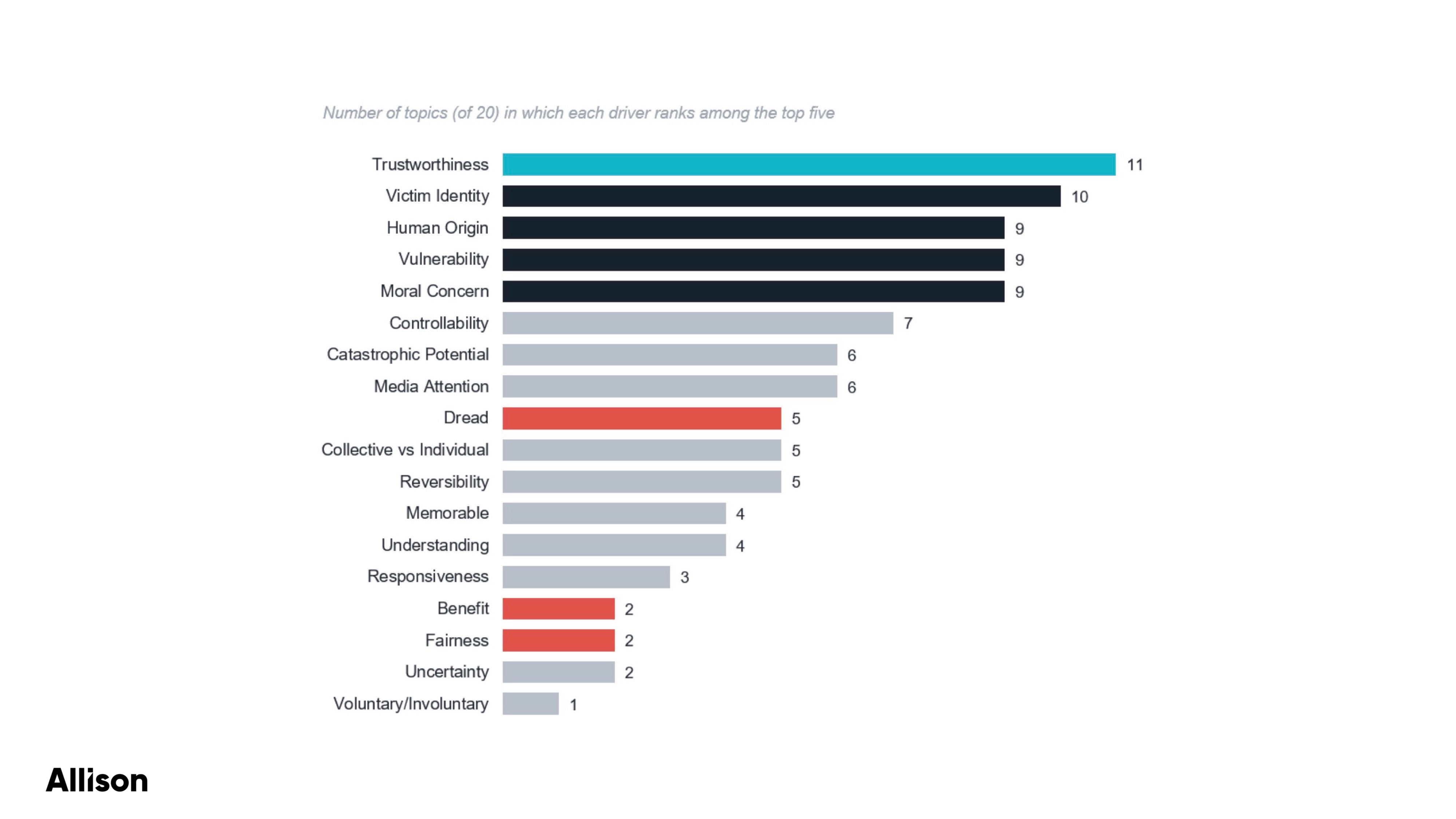
Yet, tossing out dread and leading with trustworthiness isn’t as easy as it seems, especially in a world in which broad trust of institutions, business and media is on the decline. Here, climate communicators must lean in on individuals or groups that can credibly and authentically carry a message. If a message can touch on who is impacted (victim identity) in a real and tangible way or show who is vulnerable and how humans may be responsible, then the message will start to break through.
That is why Science Moms’ Super Bowl commercial was so successful. It led with a trustworthy messenger—nonpartisan climate scientists who are also parents—and clearly articulated who the victim would be: their children.
“By the time she takes her first breath, 9 billion more tons of carbon pollution will be in the air,” the messaging said.
When Urgency Does Not Bring Action
Take this a step further and correlate climate issues with emotional intensity. While the new school of climate communications thinking has been to tie everyday weather events to climate change to bring a heightened sense of urgency and therefore, action (the “climate change is already on your front door” approach), the research shows that may actually have the opposite effect.
The analysis found that while heatwaves, drought and floods carry 80% of all coverage, all of these events sit in the bottom five range on emotional intensity. This means that while these issues are being covered broadly in news, they are not emotionally intense, and people don’t feel strongly about them.
In contrast, biodiversity loss, environmental justice and climate tipping points average 16.6 on emotion (near the top of the threshold of topics examined) but represent just under 1,000 articles each—a 36-to-1 coverage disparity. Weather events essentially dominate the news volume while high-emotion topics remain scarce. Further, across all 20 topics, emotional intensity falls as volume rises, meaning that saturation numbs while scarcity serves to sharpen.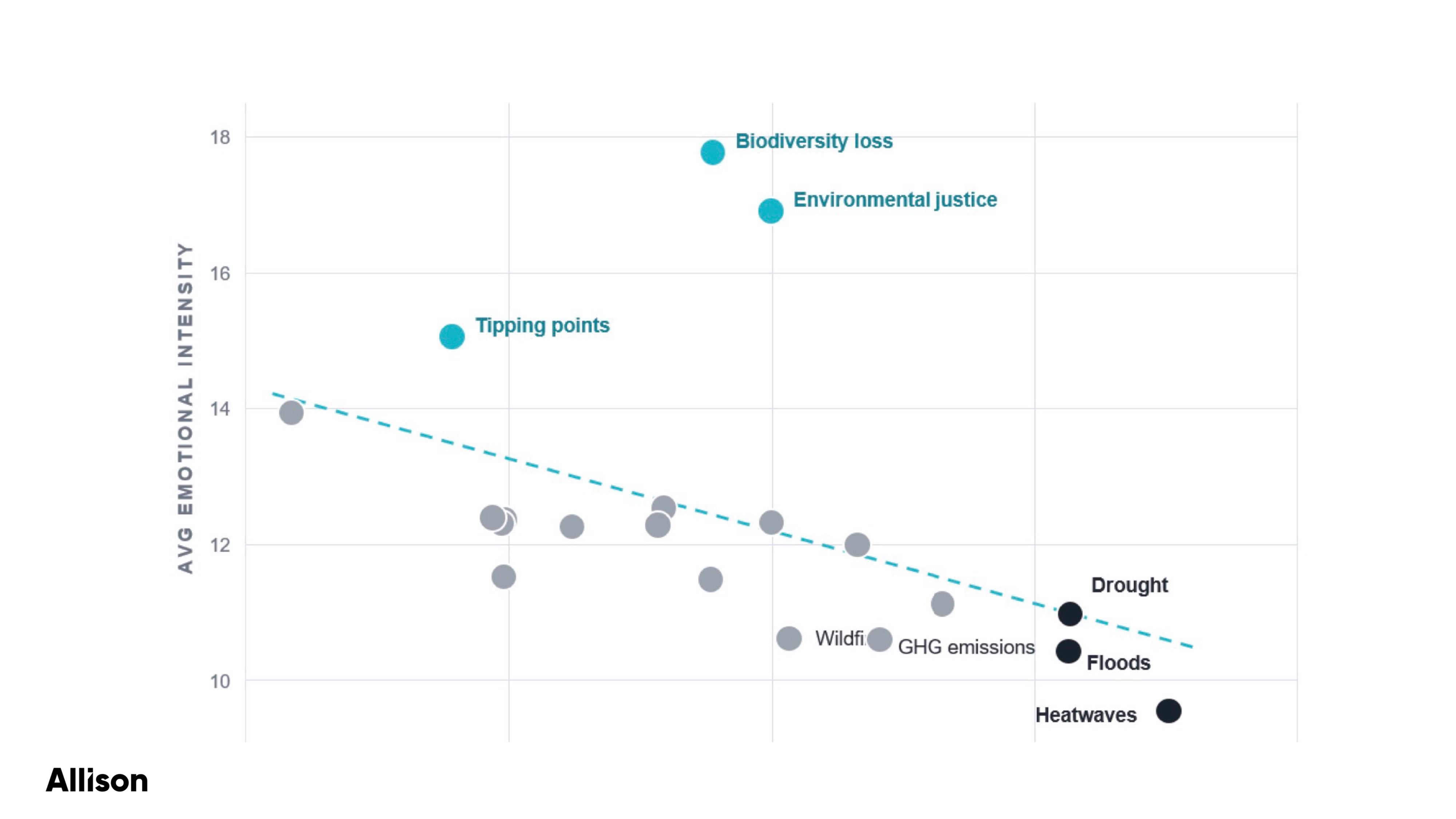
Let’s put this into perspective by examining a popular topic this summer: heatwaves. Heatwave coverage jumped from ~150 to ~1,150 articles a day in the first week of July 2026, but its emotional intensity never left the 9–11 band. This topic saw approximately eight times the media attention, with no emotional lift. Two weeks later, biodiversity loss hit 34 on this emotional scale—the summer's emotional peak—but only appeared in a handful of articles. The key insight here is that while reach came from the weather, feeling came from the blame (top emotions including: victim identity, human origin, vulnerability).
The Utility of Fairness in Climate Comms
One final point to drive home in the climate communications puzzle: which emotion is currently underutilized within the climate space? Fairness brings the highest emotional intensity (14.6) among all drivers yet appears in only two topics. By focusing climate communication on fairness-based framing—injustice, equity, who bears responsibility—rather than disaster and fear narratives, there is greater probability for emotional resonance on the topic with significantly less competition.
Climate communicators have more power than they realize. By shifting focus to these three evidence-based principles, you can move people from awareness to action:
- Lead with credibility, not catastrophe: Trustworthiness is the most common emotional door and the #1 driver for climate topics. Show the data, name the sources and admit what you don't know.
- Name the affected and the accountable: Vulnerability and Human Origin set the number one driver for half of all topics. Coverage lands when it answers two questions: who is being hurt, and who is responsible? Abstract temperature records answer neither.
- Claim the open lanes: Fairness is the highest-intensity driver in the set and appears in only two topics. This is the least-contested emotional territory in climate communication and will help communications land.
Allison Worldwide activated this research to explore which climate communications levers felt broken and what simply isn’t moving the needle anymore. The answer isn't to abandon emotion; it's to deploy the right ones to resonate with audiences. Trustworthiness. Accountability. Fairness. Solutions. These aren't soft concepts, but rather the emotional currencies that actually change minds and drive behaviors. The research has spoken. Now it's your move.
Whitney Dailey is Managing Director, Purpose, at Allison Worldwide.