

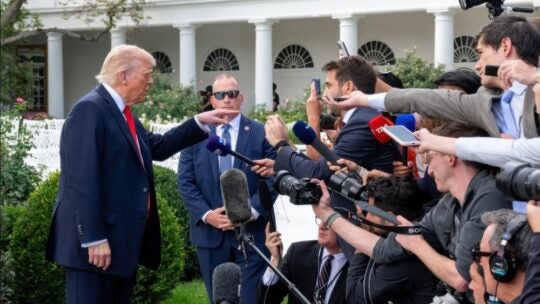
This week's PR roundup covers what the White House's ongoing press access battles mean for any organization that manages media credentialing, why DoorDash's "we screwed up" settlement statement is worth studying and what new Sprout Social data says about how holiday shoppers are spending less and expecting more from brands on social.
A Federal Judge Ordered White House Press Access Restored. The White House Still Banned Outlets.
What happened: On Sept. 18, President Donald Trump banned CNN, MS NOW and Politico from White House press access, citing what the administration later described as "behavior in violation of the standards of professionalism and decorum." The three outlets sued immediately, and U.S. District Judge Timothy Kelly—a Trump appointee—issued a ruling early on Sept. 24, ordering the White House to temporarily restore their access, finding the ban likely unconstitutional on due process grounds. The outlets had not received notice or an opportunity to be heard before their physical press passes were revoked.
What happened Thursday morning added another layer. Despite the court order, reporters from all three outlets were turned away when they attempted to enter the White House—in some cases having their hard passes confiscated by the Secret Service. The outlets filed an emergency request for an immediate hearing. Judge Kelly ordered the administration to respond by 12:30 p.m. By midday, the White House restored access: CNN's Betsy Klein went live on air from the grounds, MS NOW's Laura Barrón-López was eventually let in after initially being denied, and Politico confirmed at least one reporter gained entry—though the situation remained uneven throughout the day. The access is restored for 14 days while the case proceeds.
The ban is part of an ongoing battle between the White House and the press pool. Earlier in 2026, the White House barred the Associated Press from events for refusing to use "Gulf of America" in its reporting, before a judge ordered its access restored on First Amendment grounds. The Pentagon also faced a ruling finding it had sought to force out "disfavored journalists."
Communication takeaways: The story raises questions that extend beyond politics. The court's core argument—that once you open access to some journalists, you cannot selectively deny it to others without due process—applies broadly to any organization that manages media credentialing. The morning's chaotic non-compliance with a court order also illustrates a familiar crisis communications dynamic: when the gap between what an institution says and what it does becomes visible in real time, the credibility damage compounds quickly.
Parry Headrick, Founder and Chief Evangelist at Crackle, says the only time he’s counseled a client to avoid speaking to the press was the quiet period prior to an IPO. Other than that, he sees it as a poor strategy.
“Shutting out the press gives the impression, whether true or not, that there’s something to hide,” Headrick says. “That does two things: it erodes trust and inspires intrepid reporters to dig even harder to gather the facts. As always, sunlight is the best disinfectant.”
DoorDash's $131.5 Million Settlement Comes With a Rare Admission: "We Screwed Up"
What happened: New York City Mayor Zohran Mamdani announced a record $131.5 million settlement with DoorDash this week due to the company's non-compliance with the city's minimum pay rules for delivery workers, which took effect in 2023. Approximately 264,000 Dashers will receive payments for being underpaid or receiving late payments.
But the story worth paying attention to is how the company chose to talk about it. DoorDash published a statement on its own site titled "Making It Right: Our Settlement with the City of New York" that opens with three words rarely seen in corporate crisis communications: "We screwed up." The statement goes on to explain specifically what went wrong—technical bugs, deliveries crossing city boundaries, banking information errors—how many Dashers were affected, what the average underpayment was ($7.70, with 65% of impacted Dashers shorted by $1 or less) and exactly what the company is doing to fix it. It also acknowledges the $83 million dispute over on-call pay methodology directly, explaining that DoorDash believed its calculation approach was fair and legal but chose settlement over years of litigation.
The DoorDash statement is a useful model—and a contrast to the vague, legalistic language that typically accompanies corporate settlements. It is specific, names the error clearly, quantifies the impact, explains the fix and avoids deflecting to complexity or regulatory ambiguity. The Resonant Advisory Group credibility research covered earlier this month found that 79% of consumers say a company earns more credibility by disclosing bad news about itself first. DoorDash followed that principle.
Communication takeaways: The harder question is what comes next. A well-crafted statement is a starting point, not a finish line. Rebuilding trust with gig workers—a workforce that already has complicated feelings about these companies—requires the words to be followed by demonstrable, consistent change. DoorDash says it fixed the technical issues and strengthened its compliance program. The 264,000 Dashers receiving checks will decide whether they believe it.
Trust, as the Resonant research notes, is built or spent constantly in ordinary moments—and for DoorDash, the ordinary moments are every delivery, every payment and every interaction with the workers who make the platform run.
Michelle Bonner, VP of Public Relations at Adams & Knight, says a company doesn’t rebuild trust with just one really good apology. A company rebuilds it by making sure the behavior that got it into trouble is actually over.
“In this case, the first audience [to rebuild trust with] isn’t the customer,” Bonner says. “It’s the workers. Be clear about what changed, put real accountability behind it and then prove over time that this wasn’t just a bad chapter you’re trying to message your way past.”
Bonner also says that the biggest mistake companies make is assuming a reputation problem is just a communications problem.
“Sometimes the communications are fine,” she says. “The business’s behavior is the problem. And no brand gets to declare, ‘Trust us again.’ People decide that for you.”
Despite the suit, Bonner does not believe people are going to stop using DoorDash in large numbers, because convenience is hard to quit.
“Using a company and trusting a company are two very different things,” she says. “A customer can keep ordering dinner and still think less of the company. That loss of goodwill matters, because the next time DoorDash faces a controversy, it starts from a much lower place.”
Study: Holiday Shoppers Plan to Spend Less and Lean on Social More
What happened: Before you know it, the holiday ads will descend upon us. They seem to appear earlier every year. In fact, we may have seen one from Amazon as recently as this week. In September. On an 80-something degree day.
The holiday shopping season cannot be stopped, but it may be slowed. With tariffs and rising prices reshaping consumer confidence, more than half of shoppers (56%) plan to reduce holiday spending this year, according to Sprout Social's Q3 2026 Pulse Survey of social media users. Nearly 7 in 10 consumers are concerned about tariff-related price increases, and 36% say they plan to start shopping earlier specifically to avoid them. For brands, that means the window to earn shopper consideration is opening sooner—and the competition for attention is intensifying.
Social media is now central to the entire holiday shopping journey. Key findings:
- Social has tied physical stores as the top destination for gift discovery among all consumers (46%) and is the No. 1 discovery channel for Gen Z (54%)
- 57% of consumers are open to purchasing directly within social apps
- Promo codes from brands or influencers are the top driver of holiday purchases, followed by posts showing a product in action—targeted social ads are the least effective driver
- 50% of consumers head to TikTok for customer service during the holiday season, followed by Facebook (46%) and Instagram (44%)
- Direct messages are consumers' preferred way to contact a brand (55%)
- 70% of consumers are comfortable with brands using AI-powered tools to deliver faster customer care responses
Communication takeaways: For communicators planning holiday campaigns, the data points to a clear shift in what earns attention: utility over promotion, creators over ads and speed in customer care. Brands that show up with something useful—a discount, a demonstration, a fast response—will outperform those still relying on traditional ads.
Scott Morris, CMO at Sprout Social, says when brands conduct final check-ins on their holiday campaigns, there is a real opportunity to utilize cross-channel alignment.
“Because of a tighter economic climate, every purchase carries more weight, making it critical for brands to refine their messaging to ensure it is thoughtful and grounded,” Morris says.
Morris suggests brands support creator partners by encouraging them to keep education and utility at the forefront of their content while preparing customer care teams for fast responses.
“Our data shows shoppers are using social media for their entire holiday journey, and delivering genuine utility across that total presence helps brands maximize their ROI while building lasting trust,” he says.
Nicole Schuman is Managing Editor at PRNEWS.