

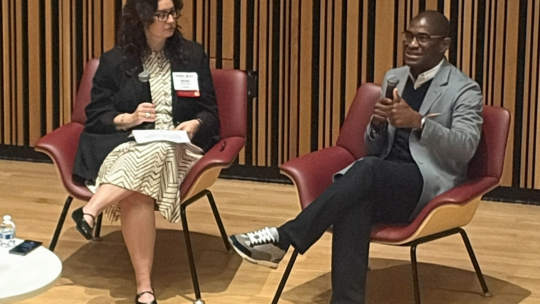
Earning attention is the whole job for AJ Jones II. At Starbucks, he led global communications and corporate affairs. Now, as Executive Vice President and Chief Strategic and Corporate Communications Officer at Monumental Sports & Entertainment, he oversees comms for the Washington Capitals, Wizards, Mystics, Team Liquid and Capital One Arena in downtown D.C.
PRNEWS Managing Editor Nicole Schuman interviewed Jones in a fireside chat on Oct. 14 at the Mid-Atlantic MarComm Summit. He shared why he believes "the future of sport is women," how his team tests messages for a global audience and why D.C. communicators should ask how a decision will age. He also explained how AI is making game day "frictionless." The conversation has been edited for length and clarity.
PRNEWS (Nicole Schuman): At Starbucks, the job was about earning attention, whether through a new location or a panda mug. Sports and entertainment already have it. How did that change your approach to comms, and what can pros in other industries take from it?
AJ Jones II: When one thinks about the attention economy...when I worked at Starbucks, my whole orientation was: How do I intervene and disrupt a pattern so that you will convert to do something different, and then create a new pattern?
When you are in the experience economy, which has four pillars—education, entertainment, aesthetic and escapism—you're thinking very deeply about: I have you in this building for two and a half hours to watch a game, to watch a concert, to experience a moment. I have curated something that you should walk away with. And the question becomes: How do I ensure that there is a value that's transmitted over time?
For many of us, when we think about fans, let's be clear: "Fans" is short for "fanatic." One of the things I have to appreciate is that people actually change teams less than they change religions. You can take it to the bank. A person is more likely to change a religion over an arc of time than they are to change a team they were born into with their families.
So, how do I ensure that there is value brought to the experience? Personalization and customization are at a premium. When you have bought a ticket, when you have decided to go to a concert, whatever that may be, I want to give you a sense of personalization, so that you feel you experienced something you could not experience in any other place, that it was rightly fitted and tuned to you, and commodifiable so that it's easy for you to engage.
Let's be clear: Aesthetic is important as well. It's the reason you're seeing more and more personalization around merch. Merch is a window into personalization because it allows you to hold that memory and keep it as you move forward.
PRNEWS: I was watching the baseball playoffs the other day, and my husband, a huge baseball fan, said, "Look at the Milwaukee Brewers hat. It is one of the greatest logos in sports." There's a little M and a B. I thought that was just a baseball mitt for years, and now I'm mesmerized every time I watch.
Jones: It is true. Logos and logo structures are what we call cultural artifacts. The Yankees logo was designed by Tiffany's, with the idea of having an aesthetic. Today, globally, you can meet people who wear the Yankees hat and don't even follow the Yankees. It's because the aesthetic is so attractive. Brand becomes something that allows for personalization of expression, even down to what you wear.
Everyone Watches Women's Sports. Comms Should Too.
PRNEWS: Let's talk about women's sports. According to research from Gather, Fortune 500 corporate involvement in women's pro sports has more than doubled. Only about 6% of these top companies backed women's leagues previously, and that figure has jumped to roughly 13%. Competition is heating up, but the market remains open for brands to step in. You've said the future of sport is women. What does that gap mean for how brands and comms teams reach this audience?
Jones: Let me give a little frame of the future of women's sport. I've said this at a number of conferences: The future of sport is women.
Since 2024, 10 women's leagues have been launched. The growth of women's sports at the college level has increased viewership by 33%. Last year, in 2025, according to Nielsen, there were 46 billion minutes watched of women's sports alone. Halfway through this year, it's already at 33 billion minutes watched.
Women's sport is also the most unique kaleidoscope within the culture. It's the reason we now talk about the "tunnel fit." Everybody is moving into that space, from Prada to Valentino to Gucci. They all understand the power of allowing sport to carry your brand. At fashion weeks and launches, the predominant number of people on those walks are disproportionately women athletes, and that will only continue to grow.
What we have to figure out is how to move across the fragmentation in women's sport, because in my opinion that's what's holding back growth. There are three levels: youth to pro; globalization and the globalization ecosystem; and athlete influencing. Some leagues are disproportionately dependent on globalized expansion, some on athlete influence and others on youth-to-pro. We have to fix those three things to allow for real growth in sponsorship, corporatization and brand positioning.
But these things are happening in rapid succession. We hosted the Professional Women's Hockey League games at our building, which had a record sellout and was the highest rated [experience] within the building. Unlike the NBA or NFL, where it took years for the ramp to happen, the ramp with women's sports is shorter and the cycles are more durable.
The other piece is the growth of sports as a durable asset class, and women are such an underpinning of this. Today, the majority of people finding their way into sport do so through adjacent content, like the shows "Drive to Survive" or "Quarterback." You're brought into the story of the sport, and then you start to follow it. Women disproportionately connect with sport this way. It's why F1 has had the strongest growth in attendance and viewership right now. If you are consistently oriented around the growth of a product, a service or entertainment content, you have to think very deeply about where you are positioning in terms of women.
Communicating to Fandom on a Global Level
PRNEWS: You mentioned globalization. I know local fans are very important as well. In terms of comms, do you provide different messaging locally or nationally versus globally?
Jones: Yes, you have to. The game is global, the players are global, the fan base is global, and that will only continue as more sports content moves from linear TV to streaming. It allows a global fan base to be created and sustained over time.
One of the teams we have the pleasure of stewarding is the Washington Capitals. Twenty-two thousand individuals will pile into our arena later today, and 84.6% of them will be wearing a jersey (of a Russian-born player), participating in a sport oriented around an American idealism at a time when tensions between Russia, the United States and Ukraine couldn't be higher. And yet that is how people have sought to engage and give two and a half hours of their time. So you have to ask: What is your local message? What is your national messaging? And most importantly, what is your global messaging?
Over the last eight years, the last eight NBA MVPs have all been foreign born. Every league—the NHL, NBA, MLB and NFL—is looking to go global and playing games globally. I'll be traveling to Mexico City on Nov. 7 for an NBA game between the Indiana Pacers and the Denver Nuggets, and it's already sold out. Forty thousand people will show up.
I also have the great privilege that owner Ted Leonsis is Chairman of the Board of the NHL, sits on the executive committee of the NBA and sits on the executive committee of the WNBA. All of them have subcommittees about the future of those sports.
That speaks to one more thing. I know you're going to ask me about AI. One thing we do is use synthetic audiences. We go across the entire globe, and we loaded the last 10 years of messaging into a synthetic messaging system to look at what messages actually carry and what could have global connectivity. Then we reposition and pitch our social channels and social content—for our players, teams and executives— accordingly.
Handling the D.C. Market
PRNEWS: Launching anything in D.C. is different from Denver or Phoenix. A president or a head of state might be in the building. How does that shape a jersey launch, a new service or a crisis response?
Jones: D.C. is a very complex city. When you are a convener, you are a steward of people's ambitions, desires and fears, and you have to hold those three things in concert with each other, even when they're in contension. At the same time, you have to deliver a product where people say, "I walked away feeling better than when I walked in."
We speak less about what is the rightly fitted, tuned position for today. Instead, we look ahead and ask: How well will that message age over time?
Here's a live example. Last year, one of the advertisers on our platforms was U.S. Customs and Border Protection. At a time of heightened conversation around their authorities and behavior, questions were asked: Do we continue to let them advertise? We said, no matter what is going on in society around this agency, they were created by the federal government. They are here for a purpose, they are employing individuals, and they are participants in the business of sport and entertainment. It is not incumbent upon us to make a judgment call about whether these people should advertise. It was responsible for us to make sure their advertising is connected to the people and audiences we serve.
PRNEWS: Did you have fans react to the advertiser...or players?
Jones: Sure. You are always going to have sensitivities because we all work through our personalized experiences and the realities that have shaped us. You don't ignore, minimize, push aside or marginalize. You take it in, and you ask yourself what the advertising could trigger or impact for a particular fan.
I often say, with sports and particularly Monumental, we've now sat through seven presidents, and we're still here. And there are going to be more presidents to come. Ted (Leonsis) has this great quote: "We're not red or blue; we're red, white and blue." Every time a new president comes in, a letter is sent saying we are here to serve and want to know how we can be of service.
Measuring the ROI of Fan Experience
PRNEWS: Everything is becoming an experience, from WNBA tunnel walks for fashion houses to the gourmet upgrades at Capital One Arena. Much of that experience lives on social and through influencers once fans leave the building. How do you think about that reach, and how do you measure whether an experience was worth it?
Jones: There are all the traditional measures. Consumer lifetime value, for example. Brand advocacy ratios. We look at all of those. But we also look at H2H interactions—human to human. How well does our social posting drive a person to want to have a human-to-human interaction? What we found is that when you have a human-to-human interaction, you're more likely to engage in an entertainment or sport activity. Some of you may have been invited to a concert or sporting event you'd never attended before, whether tennis, hockey or soccer. You went because of an H2H experience.
So the question becomes: How do we position content that drives more individuals to think about a human-to-human experience, and motivates them to engage? Once they've had that experience, people say, "Wow, I didn't know," and now they want more experiences. Then you can lower the threshold to make it easier for them to participate next time.
On the future of investment in influencers, you mentioned food. As a sports and entertainment company, we looked at the intersection between gourmet food and the rise of food channels. Over the last six years, streaming content from food channels has eclipsed drama subscriptions. More people are looking at food content as a way of engaging in entertainment on streaming platforms than are signing up for the next drama series.
So how do we partner with Aramark, one of our partners, to bring in gourmet experiences and connect them with what people are actively consuming? We were able to crosswalk consumer fans who were also watching our content on streaming to see the overlap. For those wondering, it was 41.3% between people who had at least two subscriptions to a food network and were also subscribers to Monumental's streaming content.
How AI Is Used at Monumental to Engage Fandom
PRNEWS: Sports used AI early, for performance and strategy. How are you using it on the fan side, and what does "street to seat" look like when AI is working in the background?
Jones: AI has actually been in sport for almost 20 years. It's been used for everything from analytics on plays and strategies to analytics on players: height, weight, balance, nutrition and more. It maximizes ability and helps control stress levels.
When it comes to fandom, there are two ways we've plowed in. One is moving from street to seat: the ease with which I can move you from the Metro, your car or your Uber into the venue. I know exactly what you ordered the last five times you visited, where you prefer to have that snack, where your preferred bathroom area is. When you walk in, it's frictionless. You'll see an augmented reality sign that tells you the direction of your seat. Your drink will be ready in the next five minutes. You don't have to think about anything. With that data, you get a much more immersive experience, which goes back to the experience economy. The more I can remove you from your daily realities and get you to participate in the aesthetic of immersion and escapism, the more likely you are to come back over and over, especially if I can personalize it. By the time you sit in your seat, it's not just me bringing you your order. It's me greeting you and saying, "Nicole, I've got your peanuts warm and ready, just like you like it, with a little bit of lime on the side." And Nicole says, "Thank you so much," and I can go about my game.
PRNEWS: That is wild. Well, when I get visit Capital One Arena next month, I'm going to expect a beer at my seat and a pretzel ready to go.
What PR Pros Can Steal From the Sports Playbook
- Think about how a message will age. Jones' team asks how a decision will look over time, not just what fits today. Consistent principles hold up.
- Build local, national and global messaging. Fan bases are global now. Test which messages travel, as Monumental did by running 10 years of messaging through synthetic audiences.
- Personalize the experience. Data on past behavior lets you remove friction and make people feel known, from "street to seat" to a snack ready the way they like it.
- Measure human-to-human interactions. Beyond lifetime value and advocacy ratios, Monumental tracks whether social content drives people to experience something together in person.
- Follow overlapping audiences. Crosswalk your fans' habits, such as food streaming or esports, to find new partnership and content opportunities.
- Look where growth is. Jones' view: The future of sport is women, and fragmentation (youth to pro, global and athlete influence) is the gap brands can help fix.
Nicole Schuman is Managing Editor at PRNEWS.