

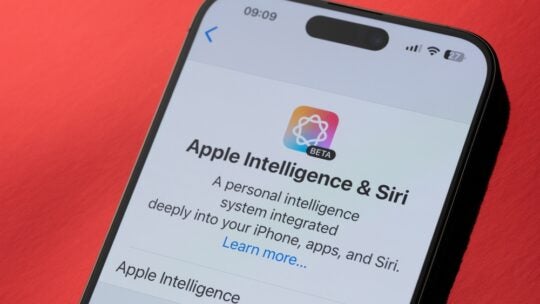
Apple built its empire on control. Now Siri needs Google.
That sentence captures the uncomfortable center of Apple’s AI problem. For decades, Apple’s promise wasn’t just beautiful devices. It was that they provided an unparalleled experience because Apple controlled more: the hardware, the software, chips, operating systems, the store, the privacy architecture, the timing and the story.
Control wasn’t a technical detail. Control was the brand.
That’s what makes the Siri problem so damaging. Siri was supposed to be the most personal interface on the most personal device Apple sells. If Apple was going to make AI feel private, useful and deeply integrated, Siri was the place to prove it.
Instead, Siri became the place where Apple’s mythology cracked, following the launch of the Apple Intelligence initiative. According to Apple’s 2024 announcements, it introduced more personalized replies, better context understanding and capabilities that let Siri know what happens across different apps.
However, in March 2025, Apple admitted that certain more advanced Siri capabilities were postponed and wouldn't appear when they were initially supposed to. Reuters reported that some improvements related to Siri, powered by AI, as postponed until 2026, and MacRumors provided a review of Apple’s statement regarding the fact that Siri features appeared much later than expected.
This news created a problematic situation for Apple, which had already faced criticism for lagging behind other companies in the race for the most innovative technology, such as OpenAI, Google and Microsoft. The Wall Street Journal later criticized Apple’s AI strategy due to problems and weak AI features implemented with Siri.
The most damning part isn’t that Siri failed at some impossible futuristic task. It’s that Siri still often feels trapped in the same narrow lane it occupied a decade ago: useful for timers, weather, texts, alarms and basic commands, but unreliable when requests require context, judgment or multi-step execution.
That isn’t a small failure. It’s a strategic one.
Siri Became the Proof That Control Wasn’t Enough
The Google pivot is what made the contradiction impossible to hide.
Apple spent decades telling the market that control is its advantage. Control means quality. Security. Privacy. Control means the messy parts of technology disappear because Apple owns enough of the experience to make them disappear.
So when Apple turned to Google’s Gemini to help power a revamped Siri, that might have been strategically smart but also philosophically awkward.
This isn’t just a vendor relationship. It cuts directly against the emotional contract Apple has spent decades selling. Apple can explain the architecture, say sensitive requests remain protected, say the user experience still belongs to Apple—and all of that may be true.
But the market hears something simpler: the company that built its reputation on owning the process needed Google's help to make Siri credible.
That’s a brutal narrative problem, especially because Apple’s AI stumble didn’t happen in isolation. It came after a stretch where Apple’s innovation story already felt less certain.
Coordinated Leaks Gave Apple the Distraction It Needed
Touchscreen MacBooks. Foldable iPhones. Smart glasses. Cheaper MacBooks. Future hardware. Leaks, reports, codenames, supply-chain breadcrumbs and rumor cycles gave the Apple media ecosystem something much more flattering to talk about.
Maybe it was a coincidence. But the timing was almost too useful.
As Siri became harder to defend, the future-hardware story got louder. As Google became part of Apple’s AI solution, the rumor cycle gave the market something else to obsess over. As Apple’s control narrative became more complicated, the company’s most reliable marketing engine—anticipation—came back to life.
That’s the real communications and marketing lesson. Leaks are usually treated as a loss of control. For most companies, they are. A leak means the message escaped before leadership, legal, product and PR could shape it.
But Apple leaks function differently. Apple has trained the market to treat rumors as part of the product experience. Entire media businesses exist to decode Apple’s smoke signals. A normal company leaks and looks sloppy. Apple leaks, and the internet starts writing the next keynote for it.
That’s why this moment is so interesting. If the leaks were truly unauthorized, they suggest Apple has become less controlled than its reputation. But if the leaks were strategically useful, they show something more sophisticated: Apple may have used the appearance of disorder to regain narrative control.
That’s the sleight of hand.
Apple didn’t need to convince everyone that Siri was fixed. It needed to make sure Siri wasn’t the only thing everyone was watching.
And it worked.
Jared Navarre is the founder and CEO of Keyni Consulting, CEO of Onnix, and chairman of the humanitarian NGOs IN-Fire and Project AK-47.