

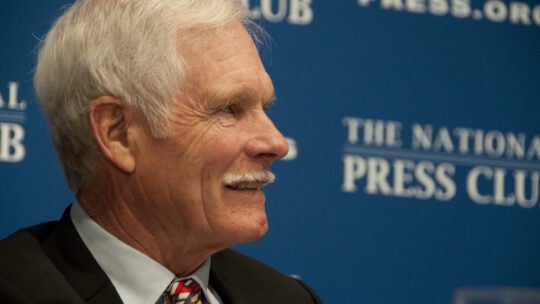
This week's PR Roundup covers the communications world's farewell to a true media original—and what Ted Turner's legacy still teaches PR pros—alongside how brands should navigate consumer messaging amid skyrocketing gas prices, and a notable platform shift as LinkedIn dethrones YouTube as the top video channel for B2B marketers.
PR Lessons from Ted Turner, CNN Founder and Media Visionary
What happened: Ted Turner, the media maverick who founded CNN—the pioneering 24-hour network that revolutionized television news—died Wednesday. He was 87 years old.
A brash but savvy visionary, Turner turned Turner Broadcasting System into a behemoth, establishing the "superstation" concept and launching channels including TBS, TNT, Cartoon Network and Turner Classic Movies. He also owned the Atlanta Braves, became an internationally-known yachtsman, and was one of the foremost landowners in the U.S., playing a crucial role in reintroducing bison to the American West.
Beyond media, Turner served as a prolific philanthropist—famously giving $1 billion to the United Nations, co-founding the Nuclear Threat Initiative and becoming one of the first to sign the Giving Pledge. He had been battling Lewy body dementia after disclosing the diagnosis in 2018 and is survived by his five children, fourteen grandchildren and two great-grandchildren.
Communication takeaways: Turner was notorious for his big, bold personality and ideas—along with the occasional media hiccup. However, since many PR pros start in journalism, CNN ended up being a place where many of them began—and a place where many of them learned fundamental PR lessons.
Michelle Bonner, VP, Public Relations and Adams & Knight, as well as a former ESPN/CNN anchor, says the biggest lesson she learned from Turner’s legacy was to “create the conversation—don’t wait to be invited into it.”
“[Turner] understood attention before attention became currency,” Bonner says. “Whether people agreed with him or not, he made them pay attention, and that’s still one of the most powerful lessons in PR today. Also… CNN wasn’t built on one moment; it was built on constant presence. That’s a lesson I think about often in PR. A single headline rarely changes perception. Consistent storytelling over time does.”
Yolanda Taylor Brigoni, Vice President, Strategic Engagement at the Elizabeth Glaser Pediatric AIDS Foundation, did not work for Turner at CNN, but as a part his team at the UN Foundation. Brigoni says Turner lived his values instead of just talking about them.
“The original Captain Planet, Ted Turner, was a true environmental activist and embedded that activism into his work,” she says. “When I worked at the UN Foundation (an organization he created), we minimized our carbon footprint when we traveled, no plastic in the office, used upcycled office furniture and even reused the printer paper. I loved how authentic it was to the culture, because it was authentic to him.”
Other communicators who did not work for Turner still found PR value in many of his actions. Meredith Eaton, Managing Director, North America at Red Lorry Yellow Lorry, says he showed how language mattered and could shift perceptions.
“Ted Turner famously enforced a strict rule to use the word "international" instead of "foreign," Eaton says. “This helped create a global, inclusive perspective and avoided making any part of his audience feel marginalized. Simple language shifts like this in PR can have a big impact!”
Michael Adorno, Partner and Senior Vice President Communications at Hot Paper Lantern, shared a more personal story and learned lesson when touring the new Turner Field, home of the Atlanta Braves, as a teenager.
“As we walked the stadium, we came to the dugout,” Adorno says. “Our tour guide offered us the opportunity to "sit where Chipper Jones and Bobby Cox sit." I asked, "Where does Ted Turner sit?" The tour guide looked at me, and said in all the years he's been giving tours that nobody ever asked that question. He then pointed to a seat directly next to the dugout and let us know that it was incredibly rare for an owner to sit in the stands and not in a box. While it was a novelty at the time, the PR lesson I took away from this is, if you're going to be the face of a brand, you need to be strategically out front and visible. I didn't know it then, but due to his dugout proximity Ted was often on screen during the games. The announcers had no choice but to discuss things he did or said during the week, and his body language could reflect and speak volumes about how he felt about the team, leading to more stories and discussions in the media. And those Atlanta teams of the late 1990's were always top of mind. Ted didn't just own an asset, he was the asset.”
Gas Prices up 50% from the Start of Iraq War
What happened: The price of a gallon of regular gasoline spiked to an average of $4.48 this week, rising 50% since the war with Iran began over two months ago. The primary driver is the effective closure of the Strait of Hormuz—the narrow Persian Gulf passage through which a fifth of the world's crude oil normally flows—which the International Energy Agency called the largest supply disruption in the history of oil markets, pushing crude as high as $112 a barrel.
There was a brief period of optimism in mid-April when a potential ceasefire raised hopes the conflict was winding down, and prices fell for nearly two weeks. But as the war continued, prices reversed course and resumed climbing. An additional factor was the Trump administration's decision to block Iranian ports to halt oil exports—a move that, while intended to pressure the region, also removed supply that had been helping moderate global prices.
Analysts warn there is no quick fix. Even if the war ended and the Strait fully reopened, experts say it could take months for prices to return to pre-war levels, as shippers and insurers will likely attach a long-term risk premium to the region.
Communication takeaways: Because gas literally makes the world economy go round, it’s not just the pump prices which will aggravate consumers. Everything connected to oil—shipping, trucking, air travel—runs on delivery typically by a gas vehicle. As costs climb, the difference will be passed on to that same consumer, combining already inflated consumer goods prices with an additional burden.
Nicole Tidei, Vice President at Pinkston, says the biggest mistake brands can make during economic volatility is acting as if consumers aren’t feeling the pressure because of those ripple effects, and silence or delayed communication can quickly erode trust.
“In moments of economic uncertainty, transparency and empathy matter more than ever,” Tidei says. “Brands that communicate early, explain impacts clearly and show what they’re doing to protect customers and employees will be far better positioned to maintain credibility.”
Tidei also notes that tone and delivery matters, and bringing calm during times of economic uncertainty greatly helps.
“Audiences are highly sensitive to messaging that feels opportunistic during periods of financial strain,” she says. “The strongest communications focus on stability, clarity and consistency. Not fear or overexplanation.”
She also acknowledges the importance of teams inside a company needing to work together, as these times are ultimately a “communications stress test.”
“Communications, operations, HR and customer-facing teams should be coordinated so stakeholders receive clear and consistent information across every touchpoint," Tidei says.
Move Over, YouTube. LinkedIn Becomes Video Go-To for B2B
What happened: Wistia, a video marketing platform recently released its 2026 State of Video Report, highlighting trends from 900-plus marketing professionals, over 13 million videos and 79 million hours of viewing data on Wistia. Key findings include:
- LinkedIn overtook YouTube as the #1 place businesses share video. 81% of businesses now name LinkedIn as their primary video channel, up 33 points in two years. YouTube is at 76%.
- AI adoption in video workflows just plateaued. After doubling from 18% to 41% last year, it dipped to 38% in 2026.
- Budgets are cooling. Only 49% of teams plan to increase video spend, down from 57% last year. But 48% are increasing distribution and promotion budgets.
Communication takeaways: Video trends seem to shift as the wind blows, (remember pivot to video being EVERYWHERE?), but the shift in platforms, at least for B2B businesses, seems to have some staying power.
Sam Balter, Head of Content at Wistia, says a big reason for that is that “engagement is the new currency.”
"For communicators, reach has long been the go-to metric, but that's changing fast,” Balter says. Social engagement has nearly doubled in two years, from 12% to 22%. The old reach-and-impressions playbook is fading.”
Balter also says that due to the rising demand for video, there’s a noticeable shift in team structures, which may also mean more work for comms teams.
“This year brought the biggest jump yet in non-video professionals getting involved in production, alongside a rise in in-house video capabilities,” Balter says. “[Because] demand for video is rising, in-house teams are using AI to produce more, while also leaning on freelancers to keep up. For B2B comms teams, this is all playing out on LinkedIn, which is now their main stage."
Nicole Schuman is Managing Editor at PRNEWS.