

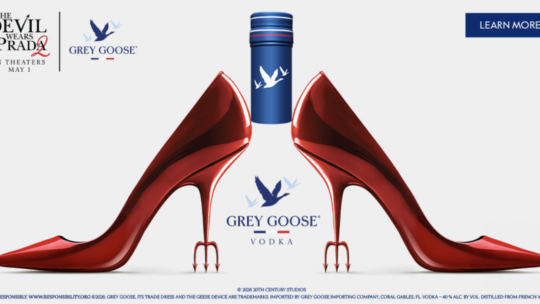
From The Devil Wears Prada 2’s curated brand blitz to Meta's attempt at community goodwill, this week offered suggestions on how companies are navigating public trust—and the gaps that remain. Meanwhile, a new national study from the Institute for Public Relations delivers an uncomfortable message to the communications industry itself: Americans want PR pros to step up on disinformation, and most don't think they are.
"The Devil Wears Prada 2" Is Hollywood's Latest Brand Partnership Bonanza—And It's Working
What happened: In the film “The Devil Wears Prada,” Runway editor Miranda Priestly delivered a masterclass to assistant Andy on how her so-called "lumpy blue sweater" was actually the color cerulean.
Twenty years later a favorite candy is following suit. M&M's just dropped a limited-edition All Cerulean pack timed with the May 1 "The Devil Wears Prada 2" release, available for free starting at 11:00 a.m. on MMS.com, while supplies last. They aren’t just blue M&Ms. They are cerulean. And apparently, the color is everywhere.
Disney mounted what it’s calling the most ambitious brand marketing partnership program in the studio's history. The key to understanding the campaign is the distinction between official collaborations and licensing deals. On the official side, the film partnered with L'Oréal Paris, Smartwater, Diet Coke, Starbucks, Samsung Galaxy, Lancôme, TRESemmé, Havaianas, Grey Goose, Google, Mercedes-Benz, Tiffany & Co. and more—while licensing deals brought in brands like Walmart, Old Navy, Lulus and Tweezerman. (For reference, M&Ms is not an official partner.)
Disney's EVP of Partnerships Lylle Breier told Marketing Dive that the goal was intentional curation, not a free-for-all. Roughly 20 brands were chosen, each owning a category, a deliberate contrast to the 400-plus licensing partners "Wicked" brought on (still happy with your "Wicked" x Le Creuset Signature Enameled Cast Iron Round Dutch Oven in “Glinda” pink purchase?).
The ROI is well-established. According to Launchmetrics, the “Barbie” movie’s collaboration with Zara generated $11 million in media impact value, while "Wicked's" partnership with Ariana Grande's r.e.m. beauty drove $15 million. Marketing Brew noted that competition to get in on "Prada 2" was fierce—TRESemmé's agency began lobbying the studio as early as fall 2024 just to lock in the haircare category.
Perhaps the most fitting? Meryl Streep wore a cerulean sweater made by J.Crew on "The Late Show with Stephen Colbert." Old Navy sold a $49.99 replica as part of its licensing deal—and it sold out.
Communication takeaways: Regardless of how "perfect" a partnership may seem from the outside, it's never a no-brainer. Cristian Gonzalez, Vice President, Head of Earned Media at RUTH, says his biggest caution to brands jumping on these cultural bandwagons is that new products and partnerships need to be authentic (we see you, green macaroni and cheese a la "Wicked").
Meta Goes (Somewhat) Transparent on Data Centers
What happened: Data centers are not popular. A Data Center Watch report found that local opposition and litigation blocked or delayed at least $156 billion in projects in 2025.
And yet, on April 28, Meta published a blog post walking readers through the basics of how its data centers work—what servers do, how cooling systems operate, why fiber cables matter. A helpful primer. Interestingly enough, the day prior Meta announced it had secured a deal to beam solar energy down from satellites in orbit to power those very data centers.
The data center explainer, aimed at a general audience, described Meta's 32 owned-and-operated facilities and noted that in the last 24 months the company broke ground on 10 new AI-optimized data centers. Several—including sites in Louisiana, Indiana, Texas and Ohio—are each expected to reach 1 GW or more of capacity once complete.
Meta’s announced energy partnership with Overview Energy will bring up to 1 GW of space solar energy to Earth—using satellites in orbit roughly 22,000 miles above the equator to beam near-infrared light down to existing ground-based solar farms, enabling them to generate power around the clock rather than only when the sun is shining. Its partnership with Noon Energy will allow for up to 1 GW/100 GWh of ultra-long-duration energy storage, capable of holding power for over 100 hours.
Communication takeaways: Dan Rene, Strategic Communications Counselor at Dan Rene Communications, published a piece in partnership with Scott Warner, Principal of Warner Strategies, back in December 2025 about community transparency not being optional when it comes to building data centers.
Rene took a look at Meta’s statement and pointed out the pros and cons. He says Meta Platforms deserves credit for recognizing that being opaque isn’t going to cut it when it comes to data centers.
“Proactively explaining infrastructure is a smart step toward building understanding and earning public trust,” Rene says.
However, Rene continues, transparency only works if it addresses the concerns people actually have.
“In this case, it's energy usage, environmental impact and community disruption…not just how the technology functions,” he says.
Rene utilized an on-point metaphor, comparing Meta’s actions to their family dentist earning trust of his kids.
“It’s nice to know how the drill and Mr. Thirsty work—but is it going to hurt?”
Rene acknowledges that Meta’s post is a big step in the right direction, but to him it felt more like an explanation than actual transparency.
“I’m all for demystifying what data centers are…it’s smart…but perhaps find more ways to address the real issues like the local opposition, land use and power consumption,” he says. “Sure, audiences are looking for information, but facts are not always reassuring.”
Americans Expect Brands to Fight Disinformation—but They Are Falling Short
What happened: The Institute for Public Relations, in cooperation with Leger, released its sixth annual Disinformation in Society Report this week. Based on a survey of 2,000 U.S. adults, the data gets pointed for communications professionals: 76% of Americans say PR and marketing pros should help combat disinformation, but only 28% think they're actually doing so—a significant trust gap.
Key findings:
- 71% say disinformation is a major societal issue on par with the economy and homelessness—the highest number in the study's six-year history.
- 76% say PR and marketing professionals should help combat it, but only 28% think they're doing so "somewhat well."
- Social platforms bear the most blame: Facebook (75%), TikTok (68%) and X (65%) are seen as leading contributors to disinformation.
- Fewer Americans are blaming AI than last year—45% in 2026 compared to 56% in 2025.
The full report is available at the Institute for Public Relations website.
Communication takeaways: That last key finding is notable. The declining focus on AI suggests the challenge may be less about technology and more about trust, transparency and communication strategy—which puts the onus squarely on communicators.
Tina McCorkindale, President and CEO of the Institute for Public Relations, says because disinformation is an ongoing business risk, society increasingly expects companies and brands to combat it, and communicators are on the front lines.
“Communicators need to move from monitoring to action and focus on strengthening trust with both internal and external stakeholders,” McCorkindale says.
She lists three immediate steps for communicators to take:
- Auditing ad spend
- Supporting local media
- Investing in information literacy, internally
“Information literacy, also called media literacy or news media literacy, teaches people how to critically evaluate information across platforms and then make informed decisions,” she says. “This helps them be more resistant to disinformation.”
[A Note: World Press Freedom Day is Sun., May 3. Thank you to all the communications and PR professionals for being a part of getting the stories out that need to be told.]
Nicole Schuman is Managing Editor at PRNEWS.