

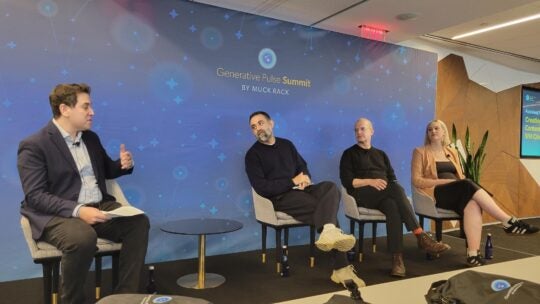
Muck Rack’s Generative Pulse Summit opened on the heels of its Dec. 2025 “What is AI Reading?” Report release, which showed just how much AI search engines rely on journalism and other forms of earned media to shape their answers.
According to the study, 94% of all citations come from non-paid sources, and 82% from earned media alone. Even more notable? The highest citation rate occurs within just seven days of publication, underscoring how quickly fresh coverage influences AI outputs.
This is good news for communicators, as AI is creating new opportunities for earned and owned media wins—a theme that threaded throughout the event on Dec. 2 in New York. In fact, press release citations are also rising fast, increasing five times since July, showcasing that the sources shaping AI narratives are shifting, tightening and becoming more consequential for communications teams.
Following are five takeaways for communicators on the topics of AI, GEO and monitoring and building trust.
1. Real-time AI search has officially changed the PR playbook.
OpenAI’s November 2024 update gave AI the ability to pull in real-time information, instantly incorporating and citing news published just minutes earlier. For PR, this is a turning point: AI now actively references earned media as it appears, making those citations even more critical.
Greg Galant, CEO of Muck Rack, said a new PR workflow is emerging due to this change.
“You'll ask AI, maybe it's about your CEO, maybe it's about a new prospect, or you’ll ask AI a question about your brand, but it doesn't say what you want it to say, and it's got a different message,” Galant said. “A year ago, it was kind of like, well, no one knows what to do about it. Now you can actually take action.”
Actions suggested include identifying which journalists’ coverage is consistently cited by AI and building media lists around the writers who have the greatest influence on AI-driven discovery.
2. GEO is forcing PR teams to operate more cross-functionally than ever.
If they aren’t already, communications, marketing, SEO and data teams must now collaborate daily—especially during launch campaigns, big news announcements and crises.
Erin Hulliberger, Group Director, Walmart U.S. Communications, spoke about the importance of monitoring your reputation in the GEO world, especially as the world’s largest retailer. Hulliberger cited the company’s recent CEO retirement as an example of teams having to work together.
“What teams did throughout the day was monitor not just the immediate coverage, but what was the conversation that was happening across AI and the LLMs?” Hulliberger said. “As the day carried forward, one of the things that [emerged] was speculation of why did Doug McMillon retire? That [speculation] became inaccurate.”
Hulliberger noted that earlier in the day McMillon did a town hall talk that was also recorded. The teams came together to extract and publish some of these videos as well as their transcripts on the Walmart press center that explained why the transition was happening. By the end of the day, AI search results cited the press center as a source.
“It’s a really quick example of [teamwork] in real time to make sure that the right narrative is in place,” she said.
3. Citations are markers of trust.
AI and GEO are having a huge impact on brand credibility, with earning citations in AI search results now established as a mark of importance.
Lexi Herosian, Corporate Communications Manager at Headspace, highlighted the role of clinicians in AI safety education, citing an op-ed penned by Chief Clinical Officer Dr. Jenna Glover that garnered significant AI attention.
“As with many industries, mental health is definitely an industry that has been transformed and disrupted by AI,” Herosian said. “As a mental health company, we do feel this kind of responsibility…a motivation to really help educate people on what makes AI safe and not safe to use. [Dr. Glover] [wrote] about the rise of AI usage in mental health, and compared it to the early days of social media, and a week after [publishing] we started seeing it show up in these different AI summaries, when someone would ask, what are the latest trends happening in mental health right now?”
Herosian noted a few key lessons from the process including using direct, straightforward language in the piece, identifying key terms used within the trending conversation, having a credentialed expert write the piece and placing it in a reputable outlet that's highly crawlable by LLMs.
4. Reddit, Medium and Quora are rising GEO power players.
These platforms show up frequently in AI answers because:
- They’re rich in human engagement signals (upvotes, comments and shares).
- They host authentic, first-person perspectives.
- They’re highly crawlable.
- And for journalists, Reddit remains a goldmine for sourcing, validating trends and engaging deeply with communities—something for PR pros to pay attention to.
For those more interested in Reddit, Gabriel Sands, Head of News and Lifestyle Partnerships at Reddit, noted the existence of the tool Reddit Pro, which serves as an analytics and social listening tool for brands and organizations.
“If brands and businesses want to be able to know how they're being discussed on Reddit and theoretically participate in those conversations, we need to provide tools to make those conversations easier to access and to parse through,” Sands said.
5. Anticipate what’s next.
As AI becomes a primary search engine, the way people learn about brands is increasingly shaped by the questions they ask—and the follow-up questions AI generates on their behalf. For PR pros and marketers, this means your narrative isn’t just defined by what you say, but by how well you prepare for the next layer of curiosity.
Shelagh Dolan, Head of Business Marketing at Quora, said anticipating follow-up questions ensures that AI has accurate, brand-aligned material to pull from, rather than relying on whatever else is out there.
“I think as a publisher or as a PR person or marketer, you want to anticipate—what are those potential follow up questions about my brand, my business or services, and at the end of the day, you want to be the one seeding that answer,” Dolan said. “So I think [brands need to] create that fan-out kind of content—and [consider] the possible angles people could be asking—and produce that themselves on the channels that tend to get picked up.”
Nicole Schuman is Managing Editor at PRNEWS.