

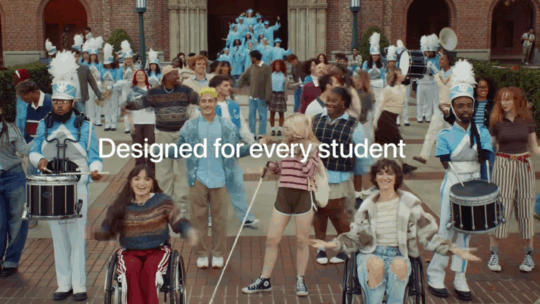
When Apple released its "I'm Not Remarkable" ad in December 2025, something remarkable happened. Set on a university campus and featuring students with disabilities navigating college life while using accessibility features, the musical ad pushed back against decades of "inspiration porn" that treated people with disabilities as superhuman for simply living their lives. With students singing lines like, "If you want inspiration, there's a library down the hall," the ad made a powerful statement: disabled people are just people, using technology to do everyday things. The response was immediate and overwhelmingly positive, with many calling it Apple's highest-scoring ad ever.
Similarly, when Maltesers U.K. ran its "Look on the Light Side" campaign featuring people with disabilities telling funny, sometimes awkward stories about their experiences, it broke through decades of storytelling that either ignored disability entirely or treated it with hushed reverence. The campaign showed that people with disabilities are funny, complex and relatable, not objects of inspiration or pity. While this was a U.K. campaign, its approach offered a masterclass in authentic representation that U.S. brands are now following.
The numbers only tell part of the story. According to the CDC, over 61 million adults in the U.S. live with a disability. That's one in four Americans. Add in their friends, families and colleagues who care about accessibility, and you're looking at the majority of the population. When brands ignore accessibility, they're not serving a small niche. They're alienating most of their potential customers.
But this goes deeper than market share. We're living through a fundamental shift in how people expect companies to show up. Accessibility in advertising isn't just about reaching more people, though that matters. It's about signaling values, building trust, and understanding that disability is part of the human experience.
What Accessible Advertising Actually Looks Like
Accessible advertising means creating content that works for everyone, regardless of how they perceive information. It's surprisingly straightforward once you understand the basics.
Take captions, for instance. They're essential for the 48 million Americans with hearing loss, but they also help anyone watching videos on mute (which is most people scrolling social media). Research shows that videos with captions see an average of 12% more engagement, with viewers being 80% more likely to watch a video to completion when captions are available.
Audio descriptions matter too. They provide narration of visual elements for people who are blind or have low vision. Netflix started adding audio descriptions to its original content years ago, and the feature has become so popular that many sighted viewers use it while multitasking. The lesson? Accessible features often improve the experience for everyone.
Color contrast is another area where accessibility meets good design. About 8% of men and 0.5% of women have some form of color vision deficiency. When ads rely solely on color to convey information, like using only red and green to show "before and after" results, they lose meaning for millions of viewers. High contrast and clear visual hierarchies don't just help people with vision differences. They make ads more readable on bright screens outdoors, on older devices and in countless other real-world situations.
The Business Case Goes Beyond Compliance
Smart brands are discovering that accessibility drives innovation and strengthens customer loyalty. When Microsoft redesigned its Xbox controller with accessibility in mind, creating the Xbox Adaptive Controller, it opened up gaming to players with limited mobility. The advertising campaign showcasing real gamers using the controller won awards and generated genuine goodwill. Microsoft didn't just make an accessible product. It told an accessible story about it, and the impact resonated far beyond the disability community.
Target learned this lesson through experience. After facing criticism and legal action over accessibility issues on its website in the mid-2000s, the company invested heavily in making both its digital properties and its stores more accessible. Today, Target regularly features models with disabilities in its advertising and has built a reputation as an accessibility leader in retail. That reputation translates to customer loyalty and positive brand perception.
Tommy Hilfiger took representation a step further with its adaptive clothing line, featuring models with disabilities in mainstream campaigns. The brand's 2019 campaign included a small girl with Down syndrome, an amputee dancer and a young surfer with cerebral palsy. The ads didn't centre on disability as inspiration. They simply showed stylish people wearing clothes designed to work for them. The campaign demonstrated that disability representation doesn't require a special "disability story." Sometimes it just means showing the reality that disabled people exist, have style and buy clothes.
Even luxury brands are recognizing the value of authentic representation. Gucci featured Ellie Goldstein, a model with Down syndrome, in its 2020 campaign for Gucci Beauty. The campaign's success challenged long-held assumptions about who belongs in luxury advertising and who aspirational marketing speaks to.
The creative opportunities are significant too. When you design with accessibility in mind from the start, you're forced to communicate more clearly. You can't rely on visual tricks or assume everyone experiences an ad the same way. This constraint often leads to stronger, more memorable creative work.
Why Now Matters
Several forces are converging to make accessibility in advertising more critical than ever before. Social media has amplified disability voices and activism. When an ad misses the mark on accessibility, the feedback is immediate and public.
When Kylie Jenner posted a photo in a wheelchair for a magazine spread without context or commentary on disability, disability advocates called it out as using mobility aids as props. The incident highlighted an important distinction: representation means including disabled people authentically, not using disability aesthetics for edgy imagery.
On the flip side, when brands get representation right, the response can be overwhelmingly positive. Going back to Apple's "I'm Not Remarkable" campaign, it featured disabled students using Apple products throughout their college experience, from attending classes to socializing at parties. Directed by Kim Gehrig (who also directed Apple's Emmy-winning "The Greatest" in 2022), the ad showed people with various disabilities as active, capable users of technology rather than objects of pity or inspiration. The musical format, with a song written by Tony Award-winning composer Tim Minchin, delivered its message with wit and authenticity. Apple even provided audio descriptions and a detailed transcript, demonstrating that accessibility applies to the ad itself, not just the products featured in it.
At the same time, Gen Z and younger Millennials expect brands to reflect diverse experiences. They're more likely to support companies that demonstrate inclusive values, and they're quick to call out those that don't. Accessibility has become part of the broader conversation about representation and equity that these consumers care deeply about.
The technology to create accessible advertising is also better and more affordable than ever. Automatic captioning has improved dramatically. Design tools now include accessibility checkers. The barriers that once made accessible advertising difficult have largely disappeared.
So, What’s Next?
Creating accessible advertising doesn't mean sacrificing creativity or diluting a message. It means thinking carefully about how a message reaches people and being intentional about inclusion. It means testing content with people who have disabilities and listening when they say what works and what doesn't.
Start with the basics. Add captions and transcripts to video content. Ensure sufficient color contrast. Use clear, simple language. Include people with disabilities in casting and portray them authentically. Make sure digital ads and landing pages work with screen readers.
But don't stop there. Think about accessibility as an ongoing practice, not a checklist. As your advertising evolves, keep asking whether it works for everyone. Keep learning from the disability community. Keep pushing your creative teams to think inclusively from the first brainstorm.
The advertising industry has always been about connecting with people and understanding what matters to them. Accessibility is simply an extension of that fundamental goal. When you create advertising that everyone can experience, you're not just expanding your reach. You're building a more honest, more human connection with your audience. In a world where consumers increasingly choose brands based on values and authenticity, that matters more than ever.
Matisse Hamel-Nelis is an award-winning communications and digital accessibility consultant and a PR professor at Durham College. She is also the co-author of "Accessible Communications."