

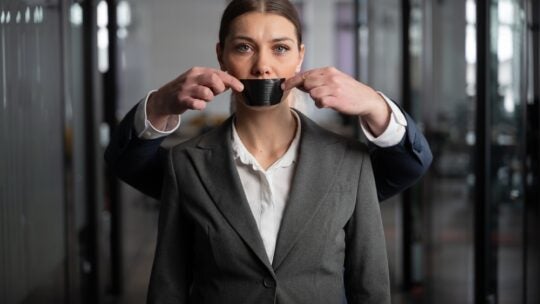
For communications leaders, there are moments when the job stops being theoretical.
When a city is under a national microscope, and employees are watching from their kitchens, discussing in their group chats, and thinking on their commutes, the questions arrive quickly and personally: Are we safe? Does leadership see what we’re seeing? Are we expected to carry on as usual?
That’s the context in which the Minnesota Chamber of Commerce reportedly rallied more than 60 CEOs to sign a letter calling for de-escalation in Minneapolis. The coordination itself was notable. Getting CEOs, boards and general counsels aligned quickly is difficult in any environment; doing it amid intense political polarization is harder still.
Predictably, the critique followed. Some called the letter “milquetoast.” But focusing on whether the language was strong enough misses the more strategic question leaders were likely confronting in real time:
Was silence the bigger risk?
Polarization Makes Silence Feel Like Safety—Until it Doesn’t
Let’s name what many CCOs have lived through in recent years: in a highly polarized environment, silence has often ostensibly been the safest option. When every word can trigger backlash from multiple directions—employees, customers, elected officials, investors, advocacy groups—“say less” becomes a rational posture.
But there is a limit to that strategy.
Silence works—until it’s interpreted as indifference. Until it erodes internal trust. Until employees conclude leadership is absent in moments that feel immediate and personal. And once a vacuum forms, it gets filled quickly: by rumor, resentment, fear, and the belief that the organization is prioritizing self-protection over people.
At that point, “safety through silence” stops being safety. It becomes reputational exposure—often the kind that is hardest to repair because it hits the core asset communicators are hired to protect: trust.
The Decision Isn’t “Strong Statement vs. Stronger Statement”
In most leadership rooms, the real choice is rarely rhetorical. It’s practical:
- Say something measured that a broad coalition can align on—knowing it may be criticized, OR
- Say nothing, and allow employees and communities to interpret the absence as avoidance—or worse.
In the current climate, silence isn’t neutral. It is read quickly and personally. And employees read it first.
The more important question isn’t whether coalition language delivers the emotional specificity some audiences want. It’s whether the organization can afford the vacuum created by saying nothing—especially when the issue is proximate, local and connected to employee safety and cohesion.
A Shift from Activism to Advocacy
If this moment signals anything, it may be that corporate voice is returning—but in a different form than the last era of corporate activism.
The last cycle often pushed companies toward broad, values-driven positioning aimed at society-wide debates. That approach can be principled, but it also invites polarization and credibility challenges (“What are you doing about it?”).
What appears to be emerging now is closer to corporate advocacy: measured communication—paired with action—tied directly to stakeholders. It’s more selective, more operationally grounded, and more centered on duty of care. Less megaphone. More stabilizer.
This isn’t a call for companies to speak more frequently. It’s a call to speak more deliberately, anchored in principles that most people can share—safety, de-escalation, human dignity—while avoiding contested framing that inflames divisions inside and outside the organization.
A Better Definition of “Unity”
One of the most useful shifts for communicators is redefining what “bringing people together” means. In companies, unity rarely means everyone agrees. It means the organization doesn’t fracture.
A practical standard is temperature: does the message lower the temperature inside your own house? Does it create room for employees to coexist—even when they disagree—without feeling forced into camps?
That may be the real discipline of modern corporate voice: not winning the argument, but sustaining cohesion and trust while the world outside is heated.
Call to Action: Change the Posture Before the Next Moment
Here is the call to action for CEOs, boards, and CCOs: stop treating corporate voice as an improvised statement-writing exercise, and start treating it as a standing operating capability.
Do three things now—before the next unignorable moment:
- Pre-decide what you optimize for. Name your priority stakeholders in high-heat situations (often employees first) and align leadership on that reality.
- Codify a “principles-first” playbook. Build language and decision screens that anchor on safety and duty of care, not on prosecuting arguments that widen polarization.
- Pair words with actions. Flexibility, security measures, employee support and local engagement are what make communications credible—and what reduce the perceived need to over-index on rhetoric.
Silence may still be the right choice sometimes. But it should be an intentional decision with eyes open to the cost—not a default born of fear.
The question isn’t whether companies can write stronger statements. It’s whether they can recalibrate to a new reality: in a polarized environment, the strategy of silence-as-safety has limits. And for many organizations, that limit is closer than they think.
Carreen Winters is President of Reputation at MikeWorldWide.