


Minnesota found itself pulled into a national flashpoint after the killing of ICU nurse and resident Alex Pretti, 37, during a U.S. Immigration and Customs Enforcement operation in Minneapolis. The shooting, captured by bystanders on phones and circulated widely online, sparked days of protests across the country, public outrage and renewed scrutiny of ICE tactics—putting pressure not just on elected officials, but on major employers and business leaders with deep ties to the state.
In response, more than 60 CEOs of Minnesota-based companies signed an open letter this week, organized by the Minnesota Chamber of Commerce, calling for “immediate de-escalation” and cooperation among federal, state and local leaders. Signatures included leaders from industry giants such as Target, Best Buy, 3M, UnitedHealth Group, General Mills, Cargill and Land O’Lakes. Professional sports teams from the state also signed on. The statement emphasized stability, safety and economic continuity for employees and communities, but stopped short of directly condemning ICE, naming Pretti or calling for a halt to enforcement operations.
An Industry Change of Heart?
The carefully orchestrated language reflects a familiar corporate PR playbook: acknowledge unrest, urge calm and avoid explicit political positioning. However, it also seems to have reignited a spark of purpose within the CEO community, as many more individuals outside of Minnesota have stepped up to condemn the killing.
According to Reuters, OpenAI CEO Sam Altman sent employees an internal message saying that ICE is "going too far" with its immigration tactics. In another internal memo to employees obtained by Bloomberg, Apple CEO Tim Cook said that he was "heartbroken" by the events in Minneapolis and called for "de-escalation.” Numerous other public figures, including former U.S. Presidents Barack Obama, Bill Clinton and Joe Biden, also posted statements online.
In recent years, many corporations have toned down political statements, hoping to avoid attention from the general public—and also the White House. However, Gregg Feistman, Professor of Practice, Public Relations at Temple University, says change could be coming.
“Although the [Minnesota open] letter itself was milquetoast, could this be an early sign of a return to corporate activism?” he asked. “We're seeing employees from across the tech sector sign a petition demanding that their CEOs cancel all company contracts with ICE and speak out publicly against the violence."
Angela Nibbs, Founder and CEO at Maven PR, noted that corporations need to find a voice when actions are impacting their immediate communities.
“National brands have tended to steer clear of politically charged issues lately, but when the tension is literally on your streets, and your workforce is part of the impacted community, silence becomes a liability,” Nibbs said on LinkedIn. “This statement doesn’t stake out a policy position or a specific call to action. Instead, it signals shared concern and a preference for stability, which is appropriate given how volatile the scene has become.”
PR Practitioners Speak Up
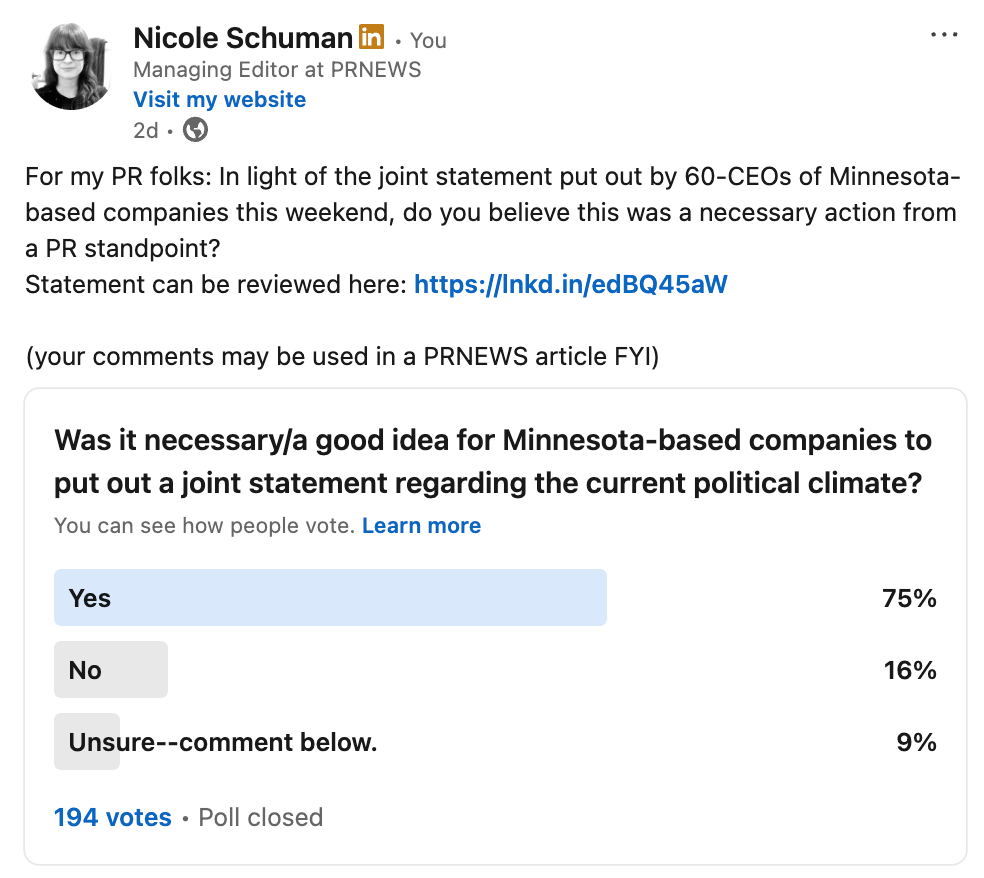
Many communicators provided their opinions via social media regarding the CEO group statement's language and intent. PRNEWS posted an informal poll on LinkedIn, taking the temperature of the industry, asking if putting out such a statement was a necessity for businesses in Minnesota at this time. A majority (75%) said yes it was necessary and a good idea, while the remaining 25% thought it was a bad idea or were unsure if it was done correctly.
What Went Right?
Many practitioners mentioned the difficulty of getting this many CEOs (and their PR legal teams) to agree to a singular statement, praising that as a feat in itself.
Cheryl Fenelle Dixon, a brand, communication and reputation consultant, said the process of getting this statement exemplifies why it could be light on substance.
“The act of issuing a statement, joining forces and using their influence for good is, by itself, admirable,” Fenelle Dixon commented. “The absence of it would have spoken more loudly and been subject to more criticism when employees and community members ask what leaders are doing to advocate for them…The intention of showing solidarity and putting something out there is more meaningful…and I doubt that any of these companies had this situation in their crisis preparedness plans.”
Annie Gudorf, EVP and Managing Director for Walker Sands, Seattle, agreed with the necessity of the statement because of the impact it has on their stakeholders.
“What’s happening in Minnesota affects these companies’ employees, customers and communities,” Gudorf said. “It's important for the community to know they have the support of their local businesses, largest corporations and their leaders. It’s also a strategic move. We know this administration pays attention to who speaks up. When it’s the right leaders at the right time, it can influence how they respond, develop policy and focus attention/resources.”
Jared Meade, Founder and Principal at Rayne Strategy Group, said he appreciated the statement put out as well as its tone.
“The statement was measured and nonpartisan, and it called for de-escalation, something we should all be able to appreciate and commend,” Meade said. “Our country is a tinderbox, and too many people are dying. Full stop. The divisive political rhetoric from all sides has done nothing but pour gasoline on the fire, and none of it has made the situation better. We need more leaders calling for a return to humanity over division. Our job as communicators is to build relationships that bring understanding and respect.”
What Went Wrong?
Still, many were disappointed in the content of the statement and what it would provide for the situation at hand.
Communications consultant Kati Murphy, said the statement said a lot without actually saying anything.
“There is no actual call to action,” she noted. “There is no transparency. There is no clear voice that shows a perspective on what happened. They’re waving flags and saying “can’t we all just get along?” My bet is that it started much stronger and some of the leaders from the larger companies refused to take a side.”
Murphy also noted that comms leaders sometimes have to walk a tightrope, and this statement is a good example.
“We understand the risk, and at the same time we know in our hearts and guts what a moment like this asks of a brand,” she said. “One of my core beliefs about brand values is that standing by them keeps your most loyal stakeholders and can also bring in new ones who share those values. Neutrality or shifting positions does neither. It costs trust and it does not win over the other side. This is the moment for brands to step up.”
Diana Kowalsky, former Internal Comms and Engagement VP at Petco, agreed on the need for action.
“I'd rather these companies spend the time it took [to write a statement] (it was likely not an insignificant amount) considering meaningful and practical action that could be taken, do that and THEN talk about it,” she said.
Rachel Ezekiel-Fishbein, Owner at Making Headlines PR, responded to Meade saying the statement needed to be stronger due to unprecedented times.
"I understand [the] point about neutrality because of the way consumers can retaliate; however, many companies choose to lead with their values," Ezekiel-Fishbein said. "This is not a typical situation they are reacting to; it is extreme and bears thinking outside of the protective bubble of neutrality."
Dan Nardo, Strategic Counsel and Crisis Expert, said the risk taken does not equal any reward—businesses need to resist the urge to comment on the political climate.
“It isn’t your place, and inserting your brand into the fray only adds to the deafening noise,” Nardo said. “Stepping into this arena invites unnecessary risk that inevitably disrupts operations and hurts your bottom line. Keep quiet. Do your job.”
And Jason Silva, Owner at Good Story Communications and a former PR pro for Reebok, noted that on the PR tightrope, it’s rare that anyone wins.
“To me it’s one of those situations where you stand to gain next to nothing by speaking, and stand to lose quite a bit by staying quiet,” Silva said.
The responses highlight the narrowing margin for neutrality in corporate communications. As social issues escalate rapidly and play out in real time, business leaders are increasingly forced to decide not just whether to speak, but how clearly—and at what risk—in moments when silence, caution or ambiguity can be interpreted as a message of its own.
Nicole Schuman is Managing Editor at PRNEWS.