

From Ye's crisis apologies and credibility questions to Oscar Mayer's bun-believable brand theatrics and Muck Rack's AI reality checks, this week’s PR Roundup highlights how communicators are navigating seriousness, spectacle and strategy all at once.
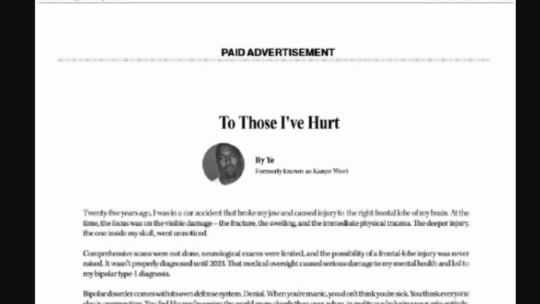
Ye (Formerly Known as Kanye West) Issues Apology Ad in WSJ
What happened: This week, Ye issued a public apology for years of antisemitic comments and behavior that have dogged his public image and business relationships over the past several years.
In a paid, full-page letter published in The Wall Street Journal titled “To Those I’ve Hurt,” Ye described his past conduct—including using Nazi imagery, making antisemitic posts on X and selling T-shirts bearing swastikas—as “reckless” and deeply regrettable. He wrote, “I am not a Nazi or an antisemite. I love Jewish people,” and said that he was “deeply mortified,” explicitly stating that he is “not a Nazi or an antisemite” and expressed remorse for amplifying hateful rhetoric.
In the letter, Ye attributed much of his behavior to long-standing mental health challenges tied to a brain injury he says went undiagnosed for years, culminating in a bipolar disorder diagnosis. He described a months-long manic episode that he said fueled his most damaging public actions, while also acknowledging that his condition does not excuse them.
Reaction to the statement has been cautious at best. Advocacy groups, including the Anti-Defamation League, acknowledged the apology while emphasizing that words alone do not undo years of harm or the real-world consequences of antisemitic rhetoric. Critics have also noted the timing of the letter, which arrives as Ye prepares to release new music, raising questions about whether the apology signals genuine change or a strategic attempt at reputational reset.
Communication takeaways: For PR pros the episode highlights a recurring challenge in celebrity crisis management: apologies lose persuasive power when they follow repeated offenses.
Seth Horowitz, Founder of Horowitz Agency, says he hopes Ye’s choice to take out the WSJ ad was a decision made on his own and not a PR stunt.
“Kanye issuing an apology was better than him not issuing an apology, especially since, as recently as last week, right-wing influencers and self-proclaimed anti-Semites Nick Fuentes, Andrew Tate and others were filmed singing Ye’s ‘Heil Hitler’ at a Miami nightclub,” Horowitz says. “Words are never as effective as someone backing those words with actions. What will Ye do to prove he means what he said?”
And although a WSJ full-page ad may seem like an odd choice for the rapper and designer, it still got people’s attention.
Horowitz notes that PR consultants might suggest paid advertising like this when a client is looking for maximum reach.
However, in high-profile cases like Ye’s, rebuilding trust requires more than a single statement—it demands sustained, visible change over time. Whether this apology marks a turning point or simply another chapter in a long-running crisis narrative remains to be seen.
The Most Anticipated Sporting Event of 2026 is…NOT the Super Bowl. It’s the Wienie 500.
What happened: The Super Bowl is tired. The Wienie 500 is wired.
Oscar Mayer is bringing back one of the most unapologetically fun brand activations: the Wienie 500. The hot dog maker announced that its fleet of Wienermobiles will once again take to the Indianapolis Motor Speedway on May 22, turning a legendary racetrack into a “bun-believable” showcase of brand storytelling. After drawing 85,000 fans in the stands and 8 million livestream viewers last year—and selling nearly half a million more wieners—the stunt returns bigger, bolder and with a new nationwide live broadcast.
This year’s race leans even harder into fan participation. Five returning Wienermobiles, each named after a regional hot dog, will compete for “Top Dog,” while the sixth spot is being left up to fans. Oscar Mayer is inviting audiences to vote via a bracket on Instagram (@wienermobile) to determine which regional dog earns a place in the lineup, adding a gamified layer to the spectacle.
“The response to the first Wienie 500 was overwhelming, and we heard the fans loud and clear that they were hungry for more,” Kelsey Rice, Brand Communications Director at Oscar Mayer says. “This year, we're supercharging the experience, delivering an event that puts the fans at the forefront. With amplified engagement, intensified rivalries and more surprises in store, we're giving the people what they want—an unparalleled live experience that will leave them craving more.”
Communication takeaways: The brand decided to double down on what made the first Wienie 500 a viral hit: absurd pageantry—from custom racing decals and Hotdogger racing suits to the “Wiener Song” anthem and a mustard-sprayed victory celebration at the “wieners circle.”
For communicators, the campaign is a reminder that experiential marketing and communications doesn’t have to take itself seriously to be effective—especially when it blends nostalgia, live events and social engagements into a single, highly shareable moment, something we don’t see a lot of nowadays in a fragmented social environment.
Rice noted the Wienie 500 as a great example of leveraging distinctive brand assets to connect with fans in unforgettable and meaningful ways beyond paid media and traditional PR tactics.
“Every detail, from the rallying “Wiener Song” anthem to the tongue-in-cheek Borg-Wiener trophy for Top Dog, reinforced our playful voice and created something only a company with 27-foot hot dogs on wheels could deliver,” Rice says. “By staying true to our identity, we surprised and delighted both those who grew up with us and those who may not be as familiar.”
Count us in the viewership for that May 22 contest!
Generative AI Adoption in PR Hits a Plateau in Muck Rack State of AI Report
What happened: Generative AI is no longer an emerging experiment in PR—it’s an established part of the workflow. Muck Rack’s 2026 State of AI in PR report suggests the industry has entered a more mature phase, where adoption has stabilized and attention is turning to governance, training and responsible use rather than rapid expansion.
Key findings in the report include:
- AI Use: 76% of PR professionals now use generative AI—a figure that’s essentially flat year over year, signaling that adoption has leveled off rather than continued to surge.
- AI Use Policies: 51% of organizations have a formal AI use policy, more than doubling since 2024—a sign that governance is catching up to usage.
- AI Training: 43% of communicators say they receive AI training at work, reflecting a shift from experimentation to structured enablement.
- AI Tools: 75% use at least one paid AI tool, underscoring that AI is becoming a budgeted, business-critical resource rather than a free add-on.
- AI Agents: Only 12% currently use AI agents, but most say they’d be more comfortable adopting them with human oversight, highlighting ongoing trust and control concerns.
Communication takeaways: Greg Galant, cofounder and CEO of Muck Rack, has been keeping a close eye on AI trends for communicators. He says that what the industry does next with AI depends on how organized and intentful they are.
“AI is already embedded in how PR work gets done,” Galant says. “What stands out in the data is that success now depends on whether teams are given the tools, training and permissions to use it effectively. Organizations that do this with clear guardrails will see better outcomes. Without that, AI either goes unused or creates more risk than value.”
Nicole Schuman is Managing Editor at PRNEWS.