


From AI-fueled reputational landmines to renewed fears over press freedom—and even a fast-food brand poking a very devoted sports fandom—this week’s PR Roundup underscores how quickly trust, tone and transparency can collide.
A new global report warns communicators that AI misuse and political polarization are accelerating reputation risk, while an FBI raid on a Washington Post reporter has sparked industry-wide concern about chilling effects on journalism and PR. We also look at how Wendy’s trademark trolling may be testing the limits of “playful banter,” and pause to remember a revered PR leader whose impact on the profession will be felt for years to come.
Top Reputational Risks for Corporations Released
What happened: It’s a new year, and reputational risk isn’t going away—but it might be taking different shapes.
Ahead of the World Economic Forum 2026 conference, the Global Situation Room and Reputation Risk Advisory council released a report on the top risks to corporate reputations.
The Reputation Risk Index is powered by insights and analysis from the Global Risk Advisory Council, which includes over 140 public affairs leaders, from former heads of state and ministers to leaders of multi-national firms.
The top 5 risks found in the report are:
- AI misuse: Harmful or deceptive use of artificial intelligence, including creating deepfakes, misinformation, biased decision-making or unethical applications that cause harm or manipulate public perception.
- Targeting by or criticism from President Donald Trump: Negative attention or consequences resulting from criticizing Donald Trump or when Donald Trump publicly attacks or criticizes an individual or organization.
- Data privacy violations: Violations of a person’s right to control how their personal data is collected, used or shared.
- Child safety/harm: Actions or accusations of putting children at risk of mental, emotional or physical harm.
- Anticompetitiveness/antitrust: Business or government actions that restrict competition, leading to higher prices, lower quality, reduced service levels or less innovation. Includes unfair market practices, monopolistic behavior, and legislation aimed at preventing or regulating trusts and monopolies to ensure fair competition.
Other risks on the list included fraud, trademark infringement and more.
Isabel Guzman, former Administrator of the U.S. Small Business Administration and Chair of the Global Risk Advisory Council, says AI has emerged as the single greatest driver of reputational risk, reshaping how trust is built—or lost—across industries.
“From deepfakes to health misinformation, its rapid evolution is outpacing regulatory and institutional safeguards,” Guzman says.
Communication takeaways: The report notes that AI misuse and attacks from the current administration often intertwine—leading to regulatory messes, legal challenges and media attention. Guzman cited examples that have added to industry uncertainty, including Reddit’s lawsuit against Perplexity over AI bots harvesting its data and lawsuits filed by families against OpenAI.
“These incidents demonstrate that when technological development outpaces regulatory safety nets or even the establishment of self-imposed industry norms, companies are left more vulnerable to reputational risk challenges,” she says.
The Council projects that these reputational risks will only intensify in 2026 and offers some advice for communicators.
“It is more important than ever to deepen organizational strength and understanding of how the intersection of AI innovation, political polarization and social media influence can affect reputation," Guzman says. “Leaders who prioritize reputational risk management will more effectively navigate this challenging environment and strengthen brand resilience."
FBI Raid Washington Post Journalist's Home
What happened: On January 14 federal authorities searched the home of Washington Post reporter Hannah Natanson, seizing her phone, personal and work laptops and smartwatch as part of an investigation into a Pentagon contractor accused of improperly retaining classified materials. Officials said Natanson and The Post are not targets of the probe, but alleged she had communicated with the contractor about sensitive information, prompting the unusual step of searching a journalist’s residence.
The raid immediately sparked backlash from press freedom groups and newsroom leaders, who warned it could have a chilling effect on confidential sourcing and investigative reporting. In a note to staff, The Post’s executive editor, Matt Murray, called the search “extraordinary, aggressive action [that is] deeply concerning,” while First Amendment advocates questioned whether the government had exhausted less intrusive options before targeting a reporter. Jeff Bezos, owner of The Washington Post, has not made any statement at this time.
Communication takeaways: The episode has renewed concerns across media and communications circles about escalating government pressure on journalists—and the reputational and legal risks such actions pose for institutions that rely on transparency and trust.
PR pros work with reporters on a daily basis. We took a quick, informal LinkedIn poll asking communications professionals whether they think this will have a chilling effect for earned media. A majority responded with their concern.
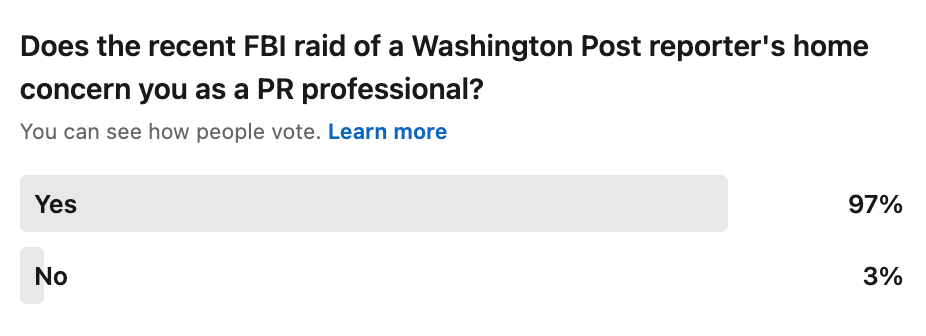
Rachel Ezekiel-Fishbein, Owner, Making Headlines PR, and a lecturer at The Wharton School, says freedom of the press is “central to our work and our nation and the press's role as the Fourth Estate.”
Nicole Yelland, Principal, Grit PR, says “more than being a PR professional, it concerns me as a regular human who consumes news for the purpose of learning about the real world around me.”
She also hopes “this empowers WaPo and other outlets to continue reporting on what's happening in the world—this story specifically—to keep their watchdog ethos intact.”
However, this is not the first time this has happened to the media, nor will it be the last. Dustin Siggins, Founder, Proven Media Solutions, says that based on the information currently available, this case looks “less like a new assault on the First Amendment and far more like the unfortunately normal actions of America’s executive branches.” He cited the Bush administration vastly expanding government powers after 9/11 with the Patriot Act, and the Obama administration accusing (before retracting) Fox News reporter James Rosen of being a co-conspirator in violating The Espionage Act as just a few examples.
However, Siggins notes, right now the important thing for PR professionals is to guide clients, principals and colleagues to wait for all the information to come out.
“We do not want to contribute to misinformation or incorrect information that must be retracted and clarified—but live forever online,” he says. “It may turn out that the Trump administration is taking things to the next level—which is concerning from free speech and good government perspectives. Or it may not be doing that at all.”
Wendy’s Beefs With Buffalo Bills fans
What happened: [Editor’s Note: Nicole Schuman is a born-and-raised Buffalo Bills fan.]
In honor of the ongoing NFL playoffs, we decided to feature a smaller crisis situation that may be snowballing for the frosty social media team at Wendy’s. Known for its quick-witted yet trolling tone, Wendy’s latest victim seems to be the Buffalo Bills.
Several fans posted confused social media posts regarding Wendy’s unwelcome commentary.
@ronikashea Stop eating Wendy’s! #billsmafia #fyp #roniKaShea ♬ Breaking News! - TheTrend
And these posts are gaining traction—BillsMafia online commentary is swelling with calls to boycott Wendy’s in response to the social media ragebaiting. Definitely something for the brand to monitor.
PRNEWS reached out to Wendy's media team, and a Wendy's spokesperson responded with this comment: "We really should know better than to tease a fanbase that calls itself the mafia. Bills fans in Buffalo—keep an eye out for a little something special from us this Saturday..."
Communication takeaways: Gabriel Gomez, Director, Head of Social, Creators & Community at MCoBeauty, says due to Wendy’s history, this is expected from the brand. However, he also notes that it can clearly backfire which is a risk brands need to weigh.
“Brand trolling can work when the brand has earned the right to participate in that tone and when the audience clearly understands it as playful, self-aware banter,” Gomez says. “That said, sports fandoms—especially ones like BillsMafia—aren’t just audiences, they’re communities with deep emotional investment.”
He notes that when a brand singles out a group repeatedly during a high-stakes moment like the NFL playoffs, the situation can quickly shift from “fun internet rivalry” to “brand punching down.”
“Engagement may spike, but sentiment starts to erode—and backlash, boycotts or calls for accountability become part of the narrative,” Gomez says. “The key thing brands sometimes miss is that engagement volume doesn’t equal brand affinity. You can win the algorithm and still lose the room.”
Condolences
Former Johnson & Johnson Chief Communications Officer Bill Nielsen passed away this week, a PR leader who touched the lives of many and contributed much to the industry.
Nielsen served as a two-time president of the Arthur W. Page Society, served on the Board of Trustees for the Museum of Public Relations, chaired the board of the Institute for Public Relations and served on the Board of Directors of the Global Public Affairs Institute, amongst many other volunteer positions and accomplishments.
We wish his family, friends and colleagues peace during this time.
Nicole Schuman is Managing Editor at PRNEWS.