


This week's roundup covers what the Canadian wildfire smoke crisis means for communicators navigating real-time emergencies, what Twitter's 20-year legacy tells us about how communications was forever changed, and why GEO is quickly becoming one of the most important—and least-owned—priorities in PR.
Canadian Wildfire Smoke Blankets the U.S.
What happened: It’s summer. It’s hot. And wildfire smog has returned.
Thick plumes of Canadian wildfire smoke have settled above parts of the Upper Midwest, Northeast and Mid-Atlantic, bringing orange-tinged, hazy skies and triggering air quality alerts for more than 124 million people. In Canada, nearly 3,500 fires have burned more than 4.8 million acres this summer, with a dozen blazes flaring up in Ontario in recent weeks. According to CBC News, poor air quality is expected to persist through Friday as new smoke clouds continue to arrive from the north.
The weather event is driven by an historic heat dome parked over the central U.S., whose edge sits directly over Ontario and Minnesota—funneling smoke east and south into major cities. Detroit, Minneapolis and Chicago ranked among the top five most polluted major cities in the world on Thursday, with statewide alerts in Michigan and Wisconsin and an advisory covering all of New York state, where N95 masks were distributed to commuters. The smoke particles can travel deep into the lungs and aggravate heart disease, diabetes and respiratory conditions for children, older adults and those with chronic illness.
While noticeable, forecasters note this event is unlikely to match the scale of June 2023, when the skyline of New York City turned a dim, apocalyptic orange. Then, 4,300 fires had already burned 25 million acres across Canada and more than 350 million people were exposed to wildfire smoke-induced air pollution. Still, CNN notes that climate change is making these seasons longer and more frequent.
Communication takeaways: The impact of wildfires on communities is is a live test of crisis readiness. Organizations with outdoor workforces, public-facing events, or operations in affected cities face real-time decisions about employee safety, event cancellations and public messaging. Those who built response playbooks after 2023 are better positioned today—and those who didn't have a clear reminder that wildfire smoke season is now a recurring communications planning consideration.
Dan Rene, Strategic Communications Counselor at Dan Rene Communications, says PR leaders should focus on putting out fires and not starting them, especially when there is smoke in the air.
“Leaders should focus first on the immediate needs of the people they serve, provide clear instructions, and update those instructions as conditions change,” Rene says.
He notes that leaders need to answer the questions people are asking: What is happening? What does this mean for me? And what should I do now?
“In an emergency situation, people should not have to search through a lengthy statement to figure out whether they should stay inside or take other precautions,” he says.
Rene’s tips for the best crisis communications? Keep them calm, specific and actionable.
“When public health and safety are at stake, the most important question is what people need to know to protect themselves right now—anything else is noise and unhelpful,” he says.
Twitter Turns 20: Two Decades That Changed How the World Communicates
What happened: Whether you are a former Twitter junkie or current verified X member, no one can argue with the impact the platform made on social media history.
On July 15, 2006, Twitter made its public debut—ushering in, as the New York Times put it, "a new era of provocative hot takes, kneejerk reactions and random thoughts on social media." What began as a simple SMS status service built inside a San Francisco podcasting company became one of the most influential communication platforms in history, reshaping breaking news, political discourse, social movements and brand communications in ways few technologies ever have.
The platform's footprint is hard to overstate. Twitter gave the #MeToo movement its name and reach, carried dispatches from Iranian protesters during the 2009 Green Movement and became the preferred megaphone for the sitting U.S. president. It produced genuinely historic moments—the first tweet from space, the Ellen Oscars selfie, alongside a stream of memes, feuds and viral absurdity that defined a generation of internet culture.
Twitter’s last four years have been turbulent. Elon Musk's $44 billion acquisition in 2022, the rebrand to X, the purge of staff, the reinstatement of banned accounts and the departure of advertisers and high-profile users have left the platform's identity unsettled. Threads now matches X in monthly users, Bluesky has attracted the Twitter/X ditchers, and X's advertising revenue dropped $100 million last quarter.
Communication takeaways: Twitter/X’s 20th anniversary is a moment worth pausing on. It didn't just change where communications happened—it changed the speed, tone and expectations of public discourse entirely. The real-time news cycle, the crisis measured in minutes, the demand for brand voice and authenticity in public conversation: all of that was shaped, and in many ways invented, by Twitter. Those norms outlasted the bird logo.
We asked PRNEWS readers if they were still including X in communications strategies. A majority in our poll said no, but many brands and individuals have still kept their accounts for image preservation and cybersecurity reasons.
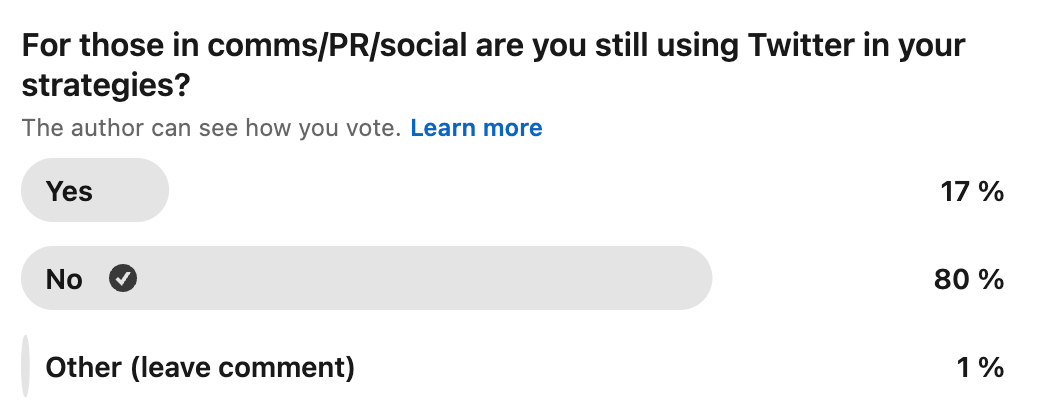
Melanie McGovern, Director, Marketing and Communications at Person Centered Services Care Coordination Organization, LLC, says they keep their account to preserve their brand and avoid imposters but do not post because their audience isn’t there.
Anna Wagner Schliep, Senior Communications Specialist for Minnesota’s 4-H says she loved Twitter early on, but stopped using it personally after its ownership changed.
“[I’m] not using it professionally anymore, either, nor am I recommending it,” Wagner Schliep says. “We are using Threads a bit more now.”
Michelle Garrett, Public Relations Consultant, lives somewhere in the middle. She keeps her account because of her media relations work, but sees it becoming less relevant.
“With some reporters still there, it made sense,” she says. “But I see more and more journalists leveraging other platforms like LinkedIn in the way they used to use Twitter/X. Because I work with B2B clients, LinkedIn is where many of them can be found now.”
Still, depending on the types of clients or organizations they work for, X makes sense for some PR pros.
Rachel Winer, EVP, Digital & Paid Media at ROKK Solutions, says X is still used widely by policymakers and engaged constituents, so it is important for amplification based on the target audience. And in her experience, its user experience has gotten better, especially compared to other platforms.
“Their current reps are actually also pretty responsive and helpful in sharing best practices and solutions to ensure successful platform performance,” Winer says. “I'd also argue that X ad engagement quality and non-bot response tends to be more controlled than Meta in some cases too.”
And Aliza Bran, Director of Media Relations at The International Spy Museum, says for a nonprofit serving a community across demographics, it should be included in the strategy.
“Offering diverse entry points to our content and connecting with the public wherever they might spend time is massively important,” Bran says. “The scope of the audience on Twitter/X is smaller than it used to be but still represents a population segment that is well worth the outreach.”
Muck Rack: GEO Is PR's Next Frontier—But No One Owns It Yet
What happened: Muck Rack's 2026 State of PR report finds the profession at an inflection point: nearly 75% of PR pros say Generative Engine Optimization (GEO) is at least somewhat important to their communications strategy, yet 29% say no one at their organization owns it— and 39% aren't measuring GEO success at all. With 61% expecting AI and automation to grow significantly over the next five years, the gap between strategic awareness and organizational readiness is noticeable.
The connection driving GEO's rise is clear: roughly 99% of AI citations come from non-paid sources, making earned media the engine behind AI search visibility. That link is pushing teams toward authority-building tactics—55% name securing coverage in high-authority publications as their top approach, while half say they are creating more data-driven content and optimizing for SEO.
The challenge is that earned media is getting harder to secure. Key findings on the current state of media relations:
- 49% of PR pros pitch more than 20 journalists per campaign
- 71% report low response rates from journalists
- 61% point to smaller or shrinking media lists
- 66% rate their work stress as high
Those shrinking lists reflect a reality covered in this roundup earlier this year: the U.S. has lost 81% of its local journalists since 2002, leaving fewer inboxes to reach and more competition for the ones that remain.
Communication Takeaways: Greg Galant, cofounder and CEO of Muck Rack, says most communicators know AI visibility matters, but aren’t sure where to go from there.
“Many companies still haven't decided who owns it or how to measure it,” Galant says. “The fact that nearly one in three PR pros say no one owns GEO at their organization tells us we're still in the early days.”
However, he notes, this is a critical moment.
“Better data and better tools can make all the difference in how we approach this shift in the PR workflow,” he says. “And it also presents a huge opportunity for communicators to take the lead. The fundamentals of PR—original insights, trusted media coverage and credible experts—are increasingly the same things that drive visibility in AI answers."