


In a recent article, Forbes listed networking as one of the top 20 skills PR professionals needed to develop to be effective at internal communications. However, networking is essential for all communications and business functions at large. And it doesn’t stop once a job is secured. Knowing who to connect with internally to move business priorities forward within a company and also who to establish longer-term relationships with beyond that particular company can make a difference for one’s career overall.
Communication College Students Need Help Networking
The U.S. Department of Labor estimates that 80% of available jobs are not advertised with experts suggesting that these are filled through professional connections. Despite this fact, most people do not network on an ongoing basis, let alone college students who are not sure what the word networking means.
I am the first and only professor at the first PR school, Boston University’s College of Communication (COM), teaching a fairly new COM Career Readiness course. It’s open to all levels and COM majors—PR, advertising, journalism, media science and film and television. The students are always surprised when I share that stat about networking, followed by the question, “How do you network?”
Defining Networking
You can't blame students for being puzzled. Definitions of networking typically describe it as a transaction that takes place between individuals. According to the journal Career Development International, “Networking is defined as goal-directed behavior, which occurs both inside and outside of an organization, focused on creating, cultivating and utilizing interpersonal relationships.”
While most professionals know they should network, according to a LinkedIn global survey, only half of those surveyed (48%) keep in touch with their networks when things are going well. The leading cause for not doing so: not having enough time, followed by not wanting to ask strangers for favors and also introverted or shy professionals feeling like they can’t effectively network.
An Opportunity to Contribute Through Networking
Instead of looking at networking as a transaction, what if we looked at it as an ongoing way to contribute value to audiences who could benefit from it in mutually-supportive relationships?
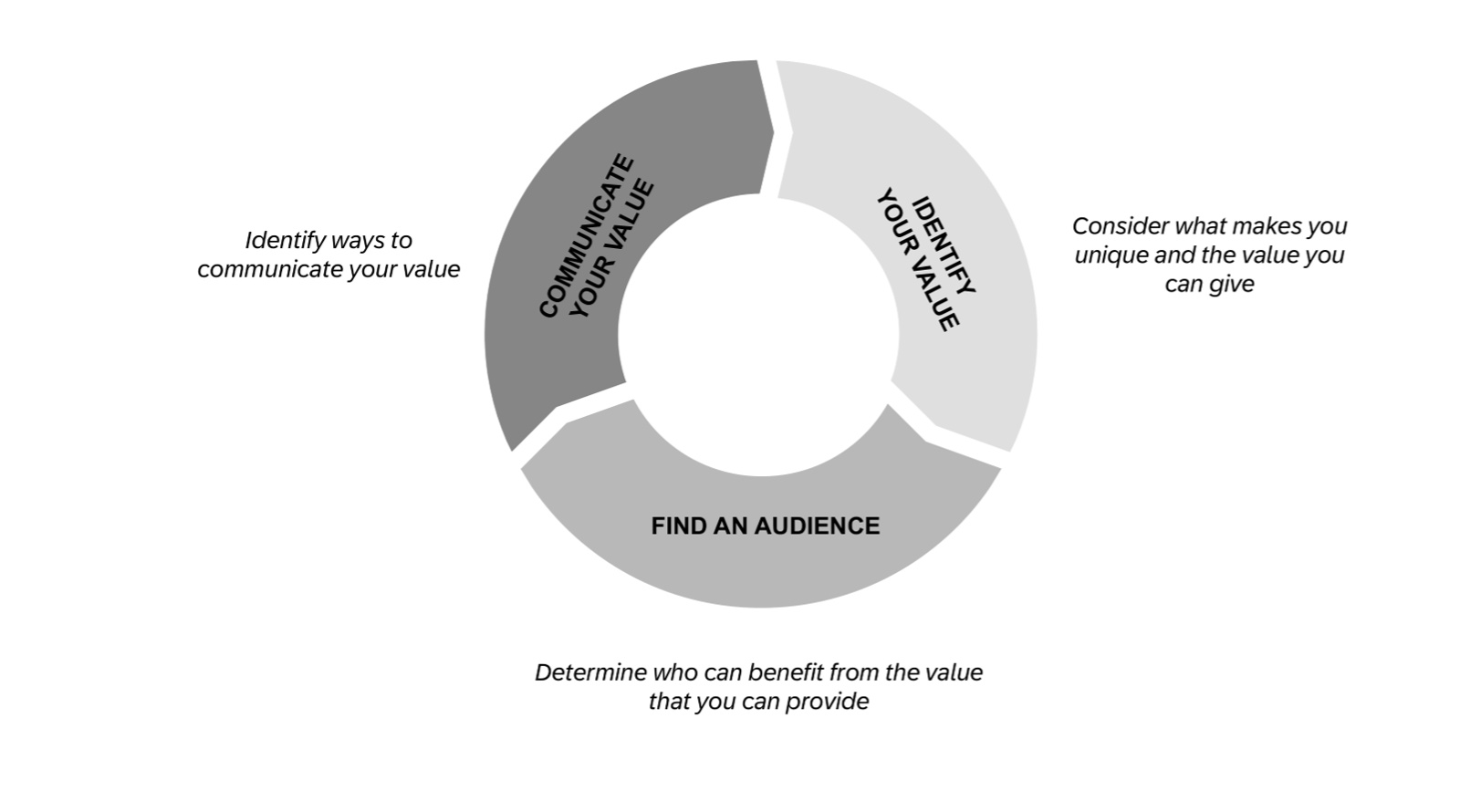
Young professionals do not often recognize that communicating their unique skills and what they want to contribute to an organization with their professors, guest lecturers, faculty advisors, coaches and family is a form of networking. In fact, it’s an example of a three-step process of effective networking:
- Identify Your Value. Consider what makes you unique and the value you can provide to an organization and/or people. As you gain more experience and widen your network, this value may evolve over time.
- Find an Audience. Not every service or company is for everyone, and neither is your value. Who can benefit from the value that you provide?
- Communicate Your Value. Identify ways to communicate your value, including through the art of storytelling. This could be through content on LinkedIn and other social media as well as at smaller, curated networking events where you can have 1:1 conversations and start to establish relationships. In other words, young professionals shouldn’t be stating, “I need a job,” but instead communicating the skills that they can contribute to an organization and industry. This helps them answer the question, “Why should we hire you?”
Considering many junior communications roles are in all-virtual or hybrid environments, seasoned professionals have the opportunity to pay it forward by introducing young professionals to others within their companies and industries. These professionals can have all the skills in the world, but if organizations are not aware of what and who they are, where does that leave these talented individuals?
Monique Kelley is an Associate Professor of the Practice at Boston University’s College of Communication, the CEO and founder of Monique Kelley Consulting, LLC and the author of “Redefining Networking: How to Lead with Your Unique Value."